6 Strategies to Improve AOV (Average Order Value) in E-commerce

As advertising costs continue to rise and competition across e-commerce platforms becomes increasingly intense, relying solely on traffic growth is no longer a sustainable strategy. Instead, many businesses are shifting their focus toward optimizing performance per customer and per transaction, where AOV (Average Order Value) has become a particularly important metric.
This article will provide an in-depth analysis of what AOV is, how to calculate AOV, and the relationship between AOV and other e-commerce metrics. It will also summarize the most common and effective strategies that help businesses increase AOV in a sustainable way.
What is AOV? The Meaning of AOV in E-commerce
AOV (Average Order Value) refers to the average value of each order. In e-commerce, AOV measures the average amount a customer spends each time they make a transaction on a website or marketplace platform such as Shopee, Lazada, TikTok Shop, and others.
To calculate AOV, divide total revenue by the total number of orders within a specific period:
Note: AOV is calculated based on orders, not individual customers. One customer may place multiple orders, and each of those orders contributes to the calculation of AOV.
In practice, AOV helps measure customer spending trends. An increase in AOV is often driven by customers purchasing higher-priced products or buying more items in each order. Optimizing AOV is important because:
- Offsetting Customer Acquisition Cost (CAC): The cost of acquiring a new customer through channels such as Facebook, Google, or TikTok ads can be very high. If AOV is lower than this cost plus the cost of goods sold, it means the business is selling at a loss. Increasing AOV helps businesses generate more revenue from the same customer they have already paid to acquire.
- Optimizing operational and packaging costs: Whether an order is worth VND 100,000 or VND 500,000, the business still incurs packaging labor, tape, and marketplace fees. A higher AOV helps reduce the proportion of operational costs relative to each unit of revenue.
- Improving marketing efficiency (ROAS): With the same advertising budget, if customers purchase more items in a single cart, Return on Ad Spend (ROAS) can increase significantly.
Example: Comparing the business performance of Company A across two periods
Although the number of orders did not increase, by implementing strategies to improve AOV, the company generated an additional average of VND 200,000 per transaction. This helped total revenue grow by 20% without incurring additional costs to acquire new customers.
Therefore, improving AOV is an important priority for businesses, as this metric has a direct impact on driving sales revenue growth.
Six strategies to improve AOV and drive revenue growth
1. Increase AOV through pricing and discount strategies
1.1. Adjust base pricing
The most straightforward way to increase AOV is to raise product prices. However, price increases may reduce the conversion rate if they are not supported by additional value. Businesses should run A/B testing for each product line, such as slightly increasing prices for exclusive products, limited editions, or bundles with high perceived value.
1.2. Threshold-based discounts
This strategy encourages customers to buy more in order to reach a specific incentive threshold, such as:
- Orders over VND 1 million get 10% off
- Buy 2, get 1 free
- Add VND 200,000 more to get free shipping
This mechanism creates a natural motivation for customers to add more items to their cart to receive the offer. According to data from ticky.io, 93% of shoppers will add products to reach the free shipping threshold. The same principle also applies to discount thresholds or free gift thresholds.
However, businesses need to carefully calculate the maximum discount they can afford and the optimal order value to ensure profitability.
1.3. The decoy effect
This is a psychological pricing tactic used to guide customers toward choosing a higher-value option.
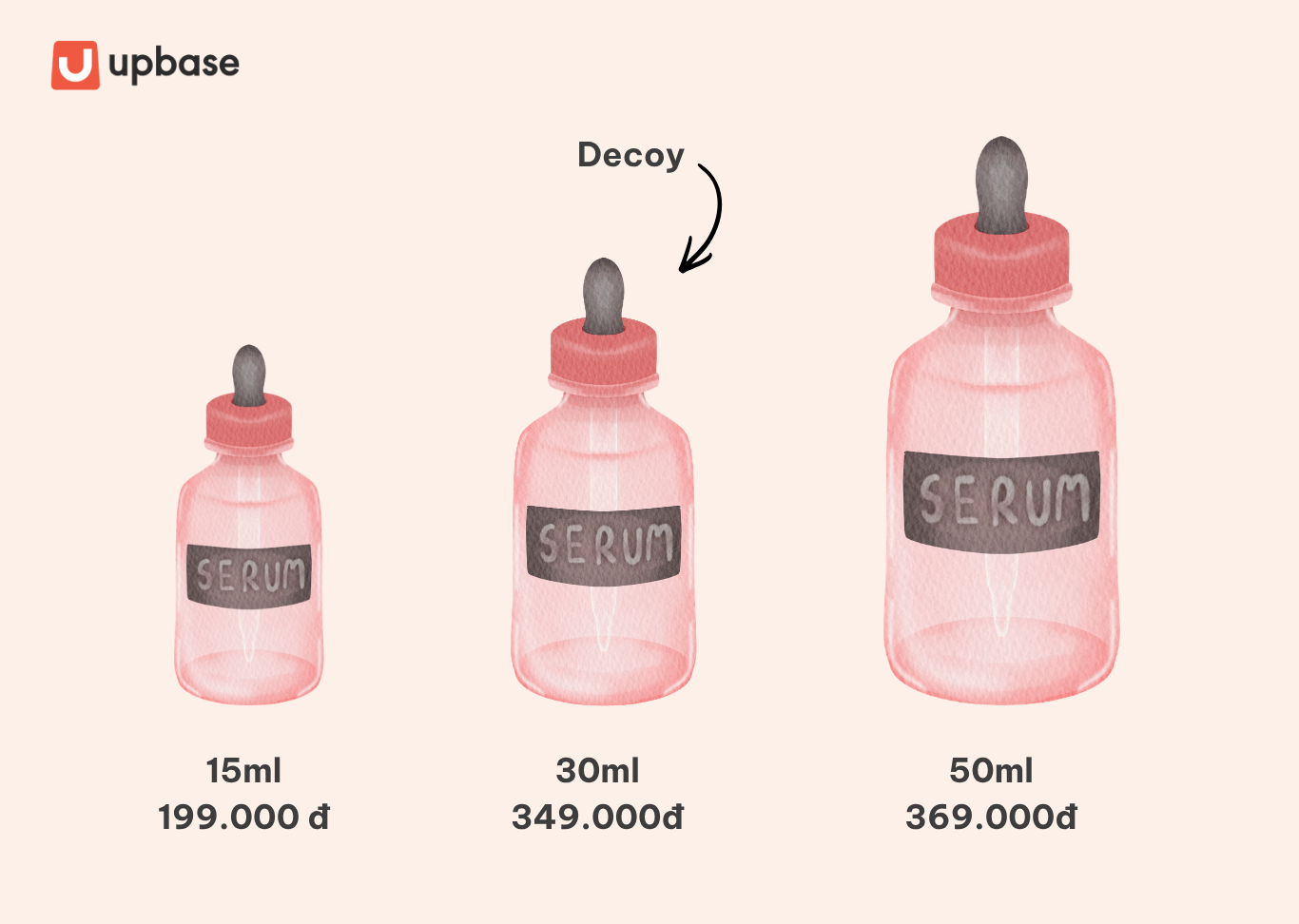
When there are only two options, customers often choose the smaller one, resulting in a lower AOV. However, when a decoy option is introduced in the middle, customers tend to perceive the larger package as better value for money because the price difference is not significant. This increases the likelihood of customers choosing the higher-priced product, thereby driving AOV upward.
1.4. Flexible payment options
For high-value products such as electronics, technology products, or premium goods, supporting installment payments or split payments helps reduce the psychological barrier to purchase. Customers are generally more willing to spend more when the pressure of immediate payment is reduced.
2. Product Bundling
Product bundling is a strategy that combines multiple related products into one promotional package to encourage customers to buy more within a single order. This is one of the most effective ways to increase AOV without relying too heavily on raising the price of individual products.
Businesses can combine complementary products into a complete set at a more attractive price compared to buying each item separately. For example:
- Skincare set: cleanser + serum + moisturizer
- Gaming combo: keyboard + mouse + mouse pad
- Mother and baby combo: diapers + wet wipes + baby wash
Bundling helps customers feel that they are getting better value, while also increasing the number of products in each order.
Read more: Five product bundling strategies & real case studies from UpBase
Advantages and limitations of Product Bundling:
3. Upsell Cross-sell
Upsell and cross-sell are two important strategies that help businesses increase order value by maximizing customer demand during the shopping journey. These are also among the most effective methods for increasing AOV because they directly leverage customers’ purchase intent when they are already ready to check out.
3.1. Upsell
Upsell is a strategy that encourages customers to choose a more premium version, a larger size, or a higher-value product package compared to their initial choice.
For example, when a customer is buying a basic coffee machine, the system can recommend upgrading to a premium version with more advanced features.
To upsell effectively, businesses should clearly display the additional benefits of the higher-tier version, provide a visual comparison between versions, and emphasize the added value instead of focusing only on the price difference.
Common upsell placement points include:
- Product detail page
- Add-to-cart popup
- Checkout page
3.2. Cross-sell
Cross-sell is the practice of recommending related or complementary products to increase the number of items in the shopping cart.
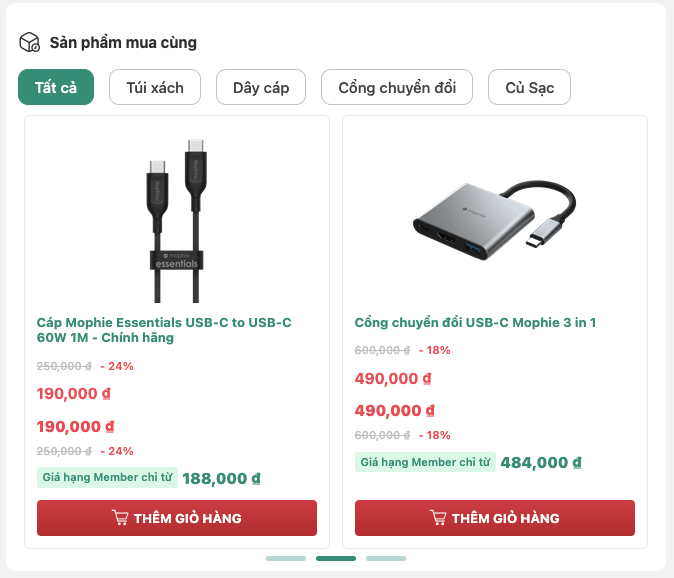
The most important factor in cross-selling is relevance. If the suggested products do not match the customer’s actual needs, customers may easily feel annoyed or perceive it as sales spam.
3.3. Down-sell
When customers reject a high-priced product, businesses can apply down-selling by recommending a lower-priced option that still ensures profitability.
- For example:
- Customers who are not ready to buy a 65-inch TV can be recommended a 55-inch TV with a voucher.
- Customers who abandon a premium product in their cart can be offered a mini or basic version.
Down-selling helps keep customers engaged instead of losing the conversion opportunity entirely.
4. Increase AOV through Free Shipping and Purchase Thresholds
Free shipping is one of the most influential factors affecting purchase decisions in e-commerce. Instead of applying free shipping to every order, many businesses choose a conditional free shipping strategy to encourage customers to increase their cart value in order to reach the incentive threshold.
Free shipping based on order value threshold: This tactic requires customers to reach a certain order value to qualify for free shipping, for example:
- Free shipping for orders from VND 500,000
- Orders over VND 799,000 receive nationwide free shipping
When customers realize they only need to add a small amount to unlock the offer, they often tend to add more products to their cart instead of paying the shipping fee. This is why this tactic is widely used on e-commerce platforms such as Shopee, TikTok Shop, and Lazada.
5. Increase AOV through Loyalty Programs
A loyalty program is a strategy that helps businesses not only increase AOV in the short term but also improve Customer Lifetime Value (CLV) in the long run. Instead of focusing on a single transaction, a loyalty program encourages customers to return more frequently and spend more over time.
5.1. Reward point system
This is the most common form of loyalty program, where customers earn reward points based on their order value. For example:
- 1 point for every VND 1,000 spent
- Redeem a VND 50,000 voucher after reaching 100 points
This mechanism creates a “progress toward reward” effect, making customers more likely to buy more in order to reach the reward milestone faster. When customers are close to redeeming a reward or upgrading their membership tier, the system can suggest that they add more products to their cart to meet the required point threshold. This helps increase AOV naturally without relying too heavily on direct discounts.
5.2. Tiered membership program
Many brands implement tiered membership systems such as Silver, Gold, and Platinum. The more customers spend, the more benefits they receive, such as free shipping, exclusive vouchers, birthday gifts, early access to new products, higher point cashback rates, and more. This tiered system creates a strong psychological incentive because customers tend to want to maintain their current status or upgrade to a higher tier so they do not lose their existing benefits.
6. Increase AOV through Promotions and Incentives
Promotions are one of the fastest ways to influence purchasing behavior and Average Order Value (AOV). When designed properly, promotional programs not only help increase short-term revenue but also encourage customers to buy more in each transaction.
6.1. Gift-with-purchase offers
This is a promotion where customers receive a free gift when their order reaches a certain value. For example, a free leather wallet for shoe orders over VND 1,000,000. Customers may add more items to their cart in order to receive the gift. Unlike direct discounts, gift-with-purchase offers help customers feel that they are receiving more value, while allowing businesses to better control profit margins.
6.2. Limited-time promotions
Limited-time promotions create a sense of scarcity and FOMO, encouraging customers to make faster purchase decisions. Time-sensitive offers can attract deal-hunting customers. Businesses can apply flash sales, tiered discounts, or short-term vouchers. When customers feel that an offer is about to end or that the quantity is limited, they are more likely to check out faster, buy more in a single order, and avoid delaying their purchase decision.
6.3. Minigames and lucky draws
Organizing minigames or lucky draws with purchases helps increase engagement and encourage spending. For example, customers who place orders over VND 500,000 receive a lucky draw entry.
Suggested Framework for Choosing the Right AOV Improvement Strategy
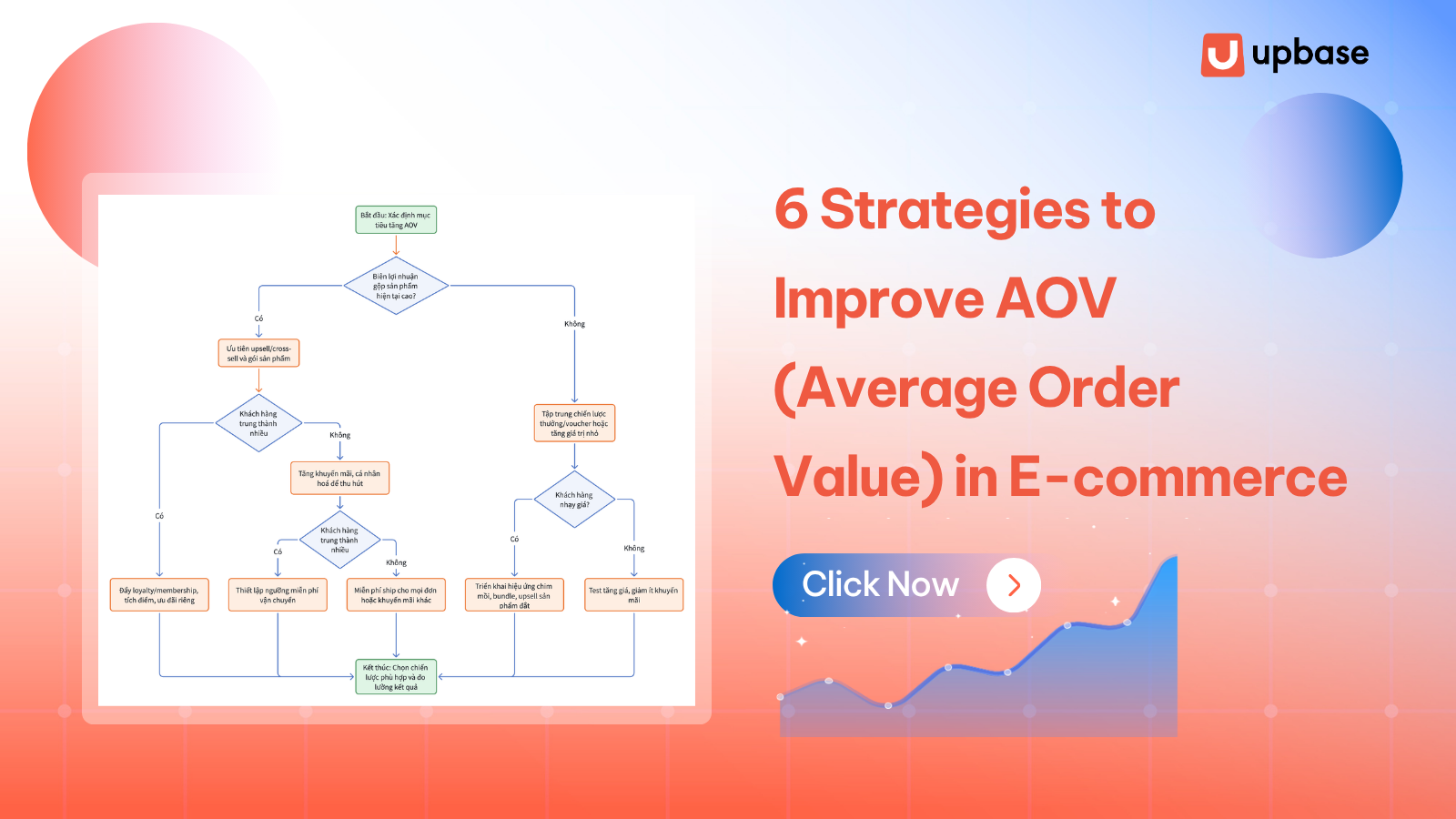
When selecting an AOV tactic, businesses need to consider profit margins, business model, and customer behavior. Below is a reference flowchart:
.png)
The Relationship Between AOV and Other Metrics
In practice, AOV (Average Order Value) is only a KPI that reflects the average value of each order. It cannot fully represent overall business performance. A business with a high AOV is not necessarily operating efficiently if its conversion rate is low, advertising costs are too high, or profit margins are reduced by promotions and operational costs. Therefore, AOV should be monitored alongside other metrics so that businesses can accurately evaluate growth performance, profitability, and the sustainability of their e-commerce operations.
In the context of rising advertising costs, operational expenses, and increasing competition in e-commerce, focusing solely on driving more traffic is no longer a sustainable growth strategy. Instead, optimizing AOV (Average Order Value) is becoming one of the most effective ways for businesses to increase revenue without relying entirely on expanding their marketing budget.
However, increasing AOV is not simply about getting customers to spend more money. An effective AOV strategy needs to create more value for customers. More importantly, AOV should be viewed in relation to other metrics such as Conversion Rate, CAC, CLV, and Profit Margin to ensure that revenue growth is accompanied by operational efficiency and actual profitability.
If your business is looking for a solution to optimize AOV, improve e-commerce operations, and drive revenue growth more effectively, you can explore UpBase’s solutions or contact us for consultation.
.jpg)


.svg)

.svg)