Key Characteristics of the Tech-driven eCommerce Enabler Model

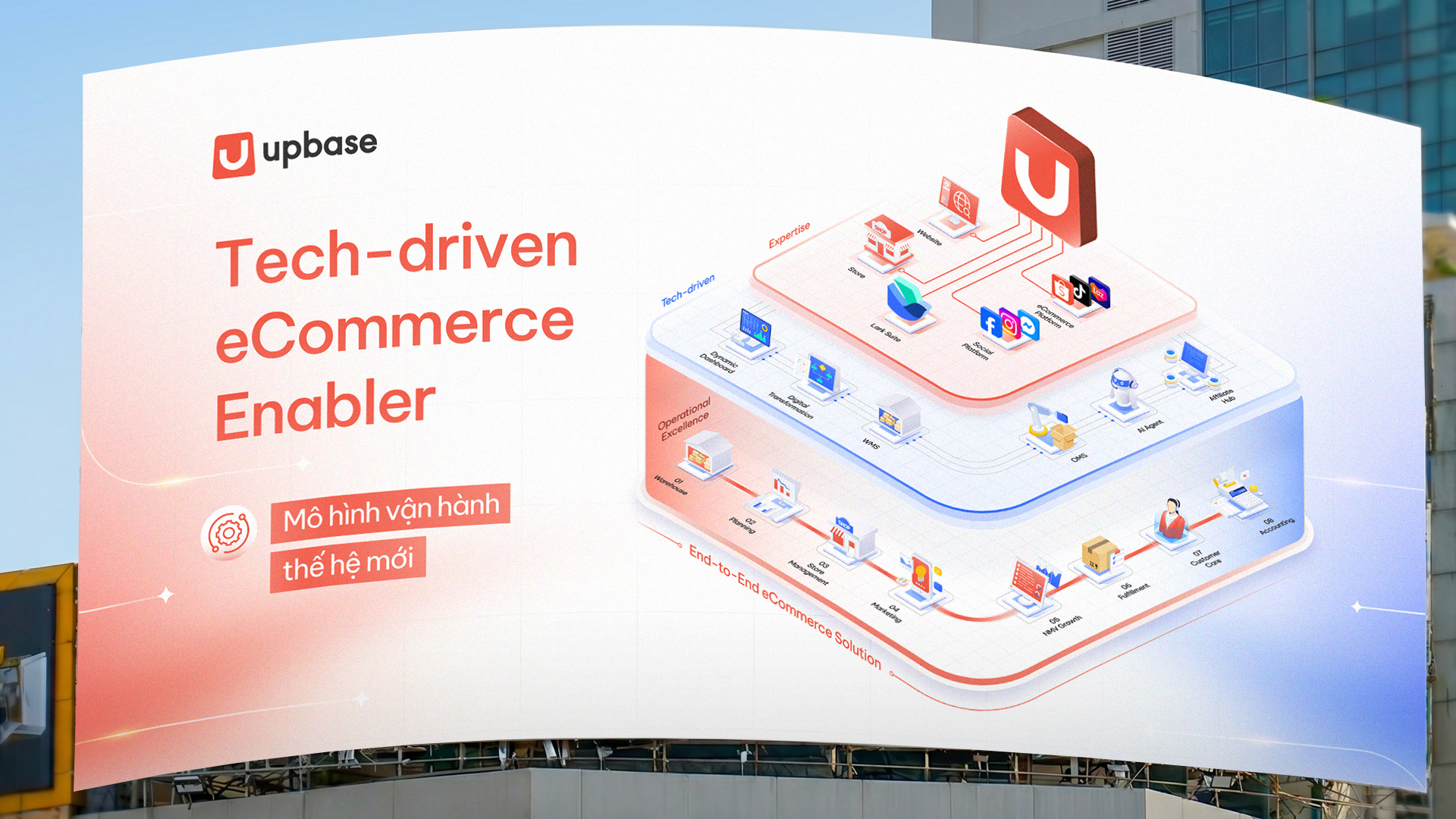
In the past, the growth formula for eCommerce was relatively simple. To drive revenue, brands mainly focused on increasing advertising budgets, launching deep-discount vouchers to stimulate demand, and optimizing traffic sources on marketplaces. Traditional eCommerce Enablers performed this role very well, thanks to large operations teams with a strong understanding of marketplace algorithms and the ability to flexibly handle every operational stage for each brand.
However, as Vietnam’s e-commerce market has moved beyond its high-growth phase and entered a period of intense competition, the operational challenge has become much more complex. Brands are facing increasing pressure from rising platform fees, escalating logistics costs, continuously higher advertising CPMs, and fiercer competition. In many product categories, total marketplace operating costs can account for up to 45% of revenue, significantly narrowing profit margins.
In this context, the manual operating model of traditional eCommerce Enablers has begun to reveal many limitations. Whenever a brand wants to scale its store, launch more campaigns, or expand its SKU portfolio, the operating partner often has to add more personnel to handle the additional workload. This makes the organization increasingly bulky, causing management and operating costs to grow linearly with business scale. As a result, operational efficiency declines, and the brand’s profit is gradually eroded over time.
It can be seen that the traditional eCommerce Enabler model was still suitable when the market was simpler and costs remained reasonable. However, it has become increasingly less flexible in response to the rapid changes of modern e-commerce.
Under this pressure, UpBase has pioneered its positioning as a Tech-driven eCommerce Enabler with a differentiated approach: using technology as the core foundation to solve operational challenges through data systems, automation, and technology-enabled scalability. Instead of relying mainly on manpower, this model focuses on standardizing processes, optimizing efficiency through systems, and minimizing manual tasks in daily operations.
As a result, UpBase can scale brand stores and execute multi-channel operations with significantly lower marginal costs, while still maintaining operational stability and quality. This helps partner brands not only optimize costs but also sustain long-term growth in a market where competition is becoming increasingly intense and profit margins are continuously being squeezed.
So, what are the core differences that make the Tech-driven Enabler model an inevitable trend in modern eCommerce?
01. Tech-driven Enablers Operate Based on Systems and Technology
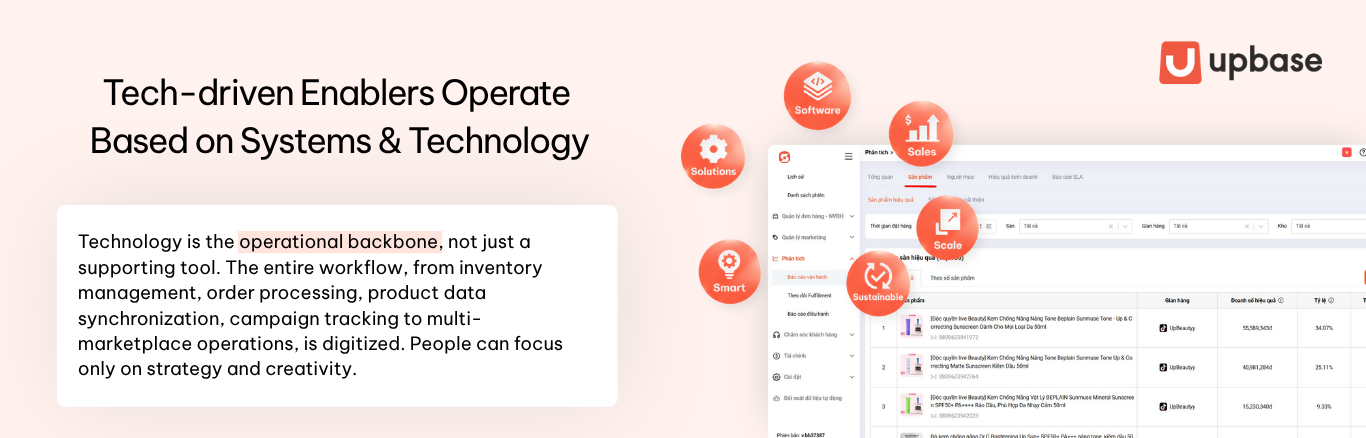
Unlike traditional operating models that rely heavily on human resources, Tech-driven Enablers place systems and technology at the center to build scalable operating processes. This model operates in a way where systems handle most of the workflows, while people focus on more strategic activities. As a result, businesses can reduce their dependence on manual tasks and improve their ability to operate at scale.
A Tech-driven system typically does not handle only one isolated task. Instead, it connects multiple operations within the same data platform, such as inventory management, order processing, product data management, campaign tracking and optimization, and more.
One of the biggest benefits of this model is that it frees up resources from repetitive tasks. Teams can focus more on building growth strategies, optimizing customer experience, creating content, and developing marketing campaigns.
02. Tech-driven Enablers Scale through Automation
In e-commerce, growth often comes with a rapid increase in operational workload. When businesses expand their product portfolio, launch more marketing campaigns, or sell across multiple channels, the volume of work also increases accordingly.
With a traditional operating model, the common approach is usually to add more personnel to meet new demands. However, this method can easily lead to higher operating costs, more complex processes, and greater pressure in team management.
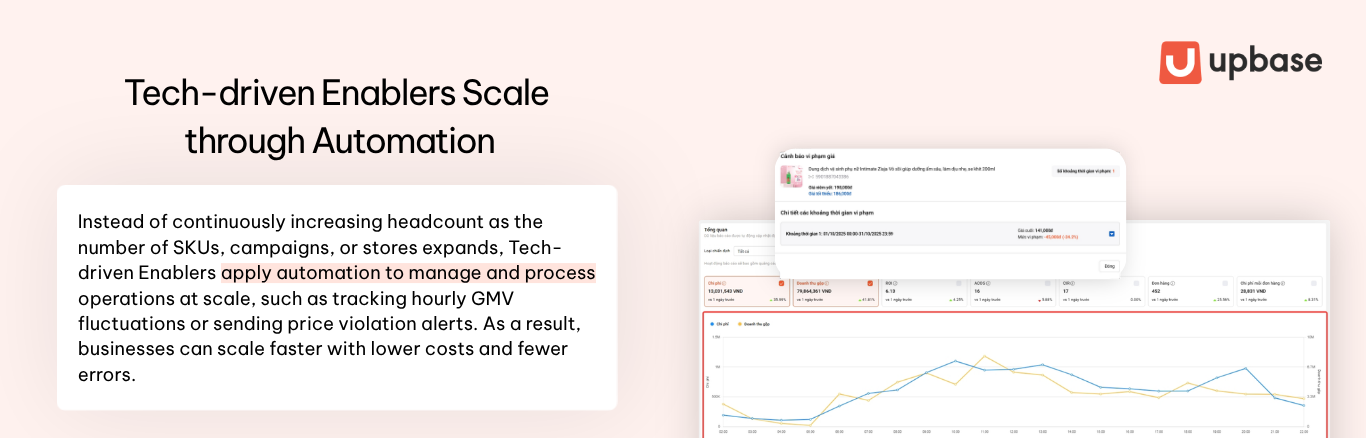
Meanwhile, Tech-driven Enablers use technology to handle most repetitive tasks, allowing businesses to operate at scale without increasing headcount at the same rate. Automation is not simply about reducing manual work; it also enables the system to proactively support businesses throughout the operating process.
For example, on UpS, businesses can track GMV by the hour instead of waiting for end-of-day reports, enabling them to detect abnormal revenue increases or decreases early. In addition, during major campaigns, applying multiple vouchers at the same time can cause the actual selling price to drop too deeply. The system can automatically send alerts when the selling price falls below the allowed threshold, helping businesses protect profit margins for each order.
.png)
3. Tech-driven Enablers Offer Superior Deployment Speed
E-commerce platforms continuously change their algorithms, update new features, and launch various sales-boosting programs. This requires businesses to respond quickly in order to capture opportunities and maintain operational efficiency.
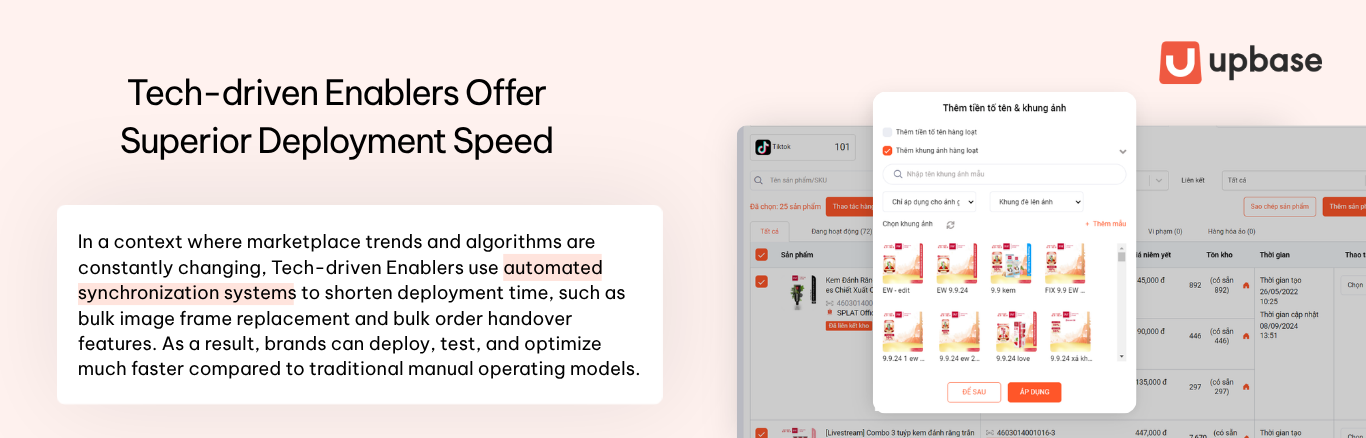
Meanwhile, Tech-driven eCommerce Enablers use synchronized systems and automation to significantly shorten deployment time. Instead of having to process each product or each store separately, the system allows multiple tasks to be carried out simultaneously at scale.
Some examples of synchronization features on UpS include:
- Changing product image frames in bulk
- Synchronizing titles, descriptions, or images across multiple stores
- Applying promotional programs in bulk
- Processing orders in bulk
In addition, the system also supports businesses in testing the effectiveness of discount programs or communication content. Instead of spending hours or even days making manual edits, the system can support near-instant deployment across multiple product groups. This helps businesses shorten testing time, collect data faster, and respond more quickly to market changes.
4. Tech-driven Enablers Make Data-driven Decisions
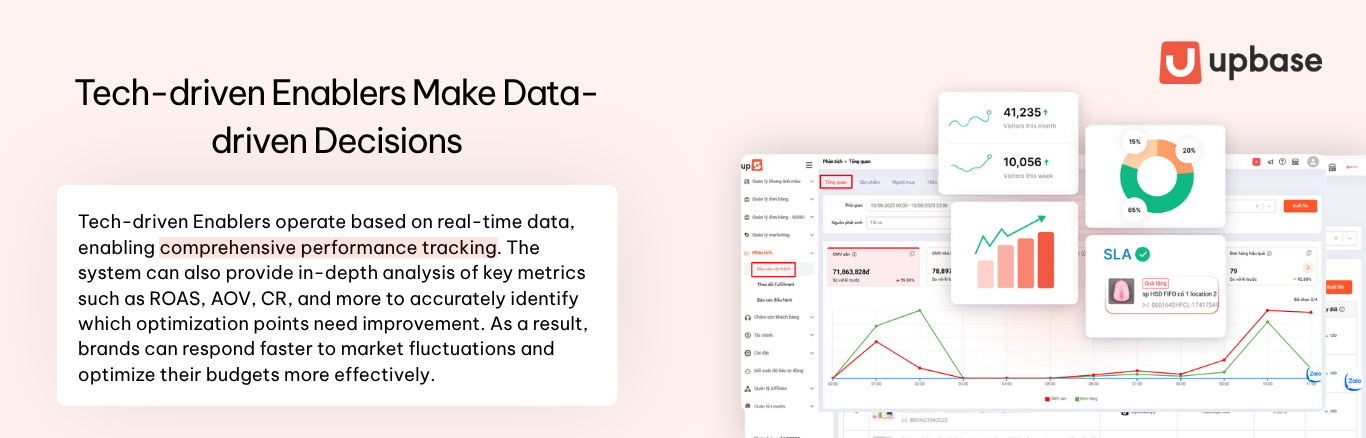
With traditional operating models, decision-making often relies heavily on personal experience, manual reports, end-of-day or end-of-week aggregated data, or observations from the operations team. This approach may work at a small scale, but when the number of products, campaigns, and data points increases, businesses can easily miss important signals.
Tech-driven eCommerce Enablers operate with a data-driven approach, using real-time data to support faster and more accurate decision-making. Businesses can monitor the overall GMV of each store by hour, by day, or by campaign. In addition, the system also supports in-depth analysis of key operational metrics such as:
- ROAS (Return on Ad Spend): advertising spend efficienc
- AOV (Average Order Value): average value per order
- CR (Conversion Rate): conversion rate
- CTR (Click-through Rate): click-through rate
- Profit Margin
For example, if GMV increases but profit declines, the system can help quickly identify whether the cause comes from an unusual increase in advertising costs, excessive voucher discounts, higher marketplace fees, or a drop in conversion rate.
5. Tech-driven Enablers Apply AI to Improve Operational Efficiency
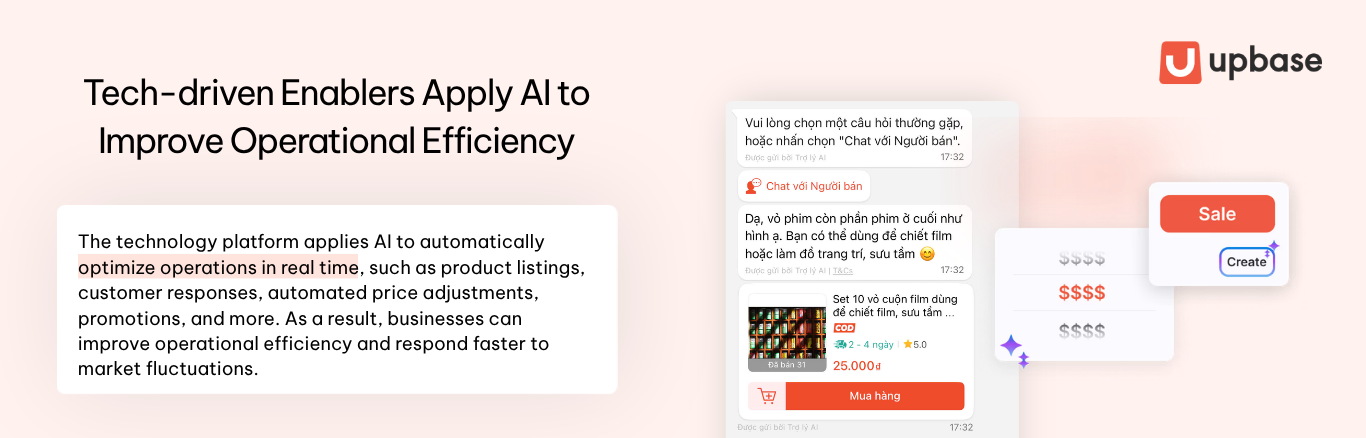
Tasks such as product management, price optimization, customer response, and campaign performance tracking can consume a great deal of time and resources if handled entirely manually. This is why Tech-driven eCommerce Enablers integrate AI into their operating systems to increase processing speed, reduce repetitive tasks, and improve overall efficiency.
Unlike using AI as a standalone tool, this model embeds AI directly into the operating workflow so the system can proactively analyze, recommend, or automatically handle multiple tasks.
One of AI’s key strengths is its ability to process large volumes of data continuously and respond quickly to market changes. For example, the system can support:
Product listing optimization
- Suggest more suitable product titles
- Recommend keywords that can improve visibility
- Support product description optimization
- Automatically create or update content
AI-powered customer service support
- Automatically answer frequently asked questions
- Suggest context-appropriate responses
- Classify customer requests
- Forward complex cases that require deeper handling
AI-powered pricing and promotion optimization
- Track price fluctuations
- Suggest suitable price adjustments
- Alert when pricing may affect profitability
- Optimize promotional programs
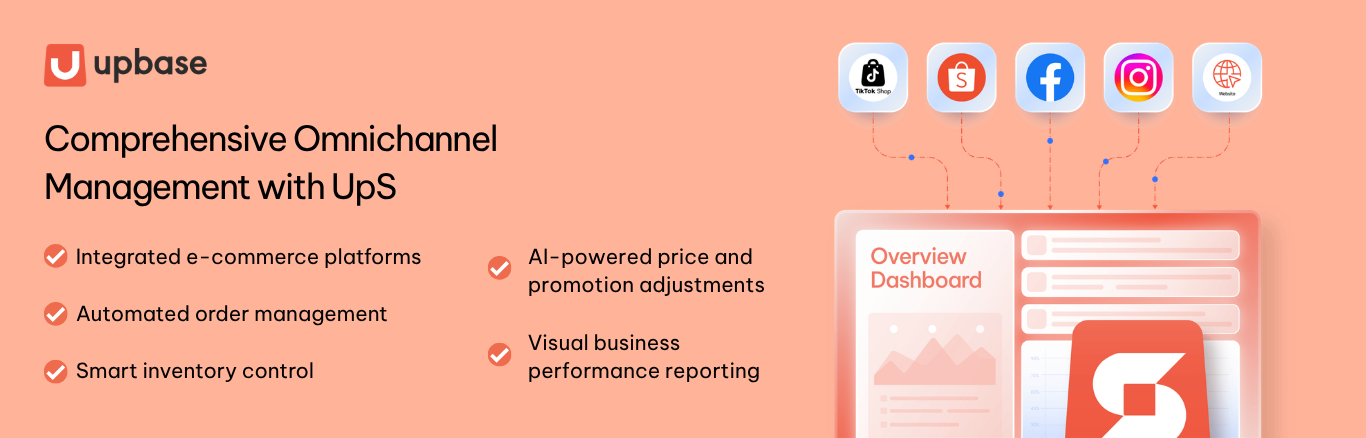
Comprehensive Omnichannel Sales Management with UpS
Positioned as a Tech-driven eCommerce Enabler, UpBase combines hands-on operational experience with technological capabilities to build a sustainable growth ecosystem for businesses. UpBase focuses on developing solutions based on the UpS platform, helping partners optimize the entire business process and scale faster in e-commerce. Contact UpBase for consultation!
.jpg)


.svg)

.svg)