Digital transformation in Retail: Solving complex operational challenges through centralized management

.png)
In the retail industry, business growth often comes with increasingly complex operational challenges. In many enterprises, the lack of synchronization between Human Resources, Accounting, and Sales departments across disconnected platforms frequently leads to fragmented data and bottlenecks in operational workflows. As a result, leadership teams struggle to gain a comprehensive view of business performance and monitor work progress in a practical and accurate manner.
This article provides an overview of digital transformation in retail, breaks down the core operational modules, and introduces a solution that enables businesses to achieve comprehensive and flexible digital transformation while still maintaining operational efficiency and simplicity.
1. What is digital transformation in retail?
Digital transformation is the process of applying digital technologies to comprehensively restructure a business model, operational processes, and customer experience. Similarly, in the retail industry, digital transformation reshapes how businesses sell products, manage internal operations, and organize their workforce. All activities are connected in real time through the following core components:
- Sales management: Digitizing in-store operations, online sales channels, marketing campaigns, and order management.
- Supply chain management: Optimizing purchasing processes, inventory management (inbound, outbound, stock control, and stocktaking), and product delivery.
- Human resource management: Digitizing recruitment, employee records, attendance tracking, payroll, and training.
- Operations & administration: Professionalizing asset management, task management, document handling, approval workflows, and internal communications.
- Finance & accounting: Automating revenue recognition, expense tracking, receivables/payables management, and payment gateway integration.
Unlike traditional operating models that rely heavily on experience and intuition, digitally transformed retail models focus on data-driven decision-making. When operational data is connected across departments, businesses can respond more quickly to market demands, optimize resources, and minimize risks.
At a deeper level, digital transformation in retail represents a systematic shift aimed at achieving operational excellence and sustainable growth based on three core pillars:

- Process x: Businesses need to establish standardized operating procedures (SOPs) and comprehensive operational workflows. Every operational activity should be clearly defined with measurable performance indicators to ensure consistency as the business scales.
- People x: Technology can only deliver real value when employees are ready and capable of utilizing it effectively. Roles and responsibilities must be clearly defined, with a management mindset driven by data. At the same time, employees need to be equipped with digital skills to fully leverage and maximize the capabilities of the new system.
- IT x: The technology infrastructure serves as the foundation for automation. The system must ensure centralized, real-time data flow while integrating the power of AI and automation to streamline repetitive tasks, allowing resources to focus on more strategic initiatives.
2. Operational management challenges in retail businesses
In retail management, operational complexity often grows faster than the business itself. As companies expand from 1 to 10 or even 100 stores, operational issues that were once manageable through manual processes quickly become barriers that hinder growth.
- Complexity in scaling operations: As the business expands, the number of operational touchpoints increases exponentially. Managing work shifts for hundreds of employees, coordinating inventory across multiple warehouses, or ensuring compliance at every store becomes significantly more difficult. Without standardized processes, businesses often end up expanding their workforce while seeing productivity per square meter decline. This lack of operational consistency makes scaling both challenging and prone to higher risks of error.
- Fragmented information across stores: Each store or sales channel may operate differently, resulting in inconsistent processes throughout the system. Reporting still relies heavily on manual methods, meaning data is not updated in real time and decision-making is often delayed. As a result, optimizing inventory, pricing strategies, or marketing campaigns becomes increasingly difficult.
- Lack of centralized internal communication: Work-related communication is often fragmented across too many channels such as Zalo, Messenger, Email, and others. Since communication is not directly connected to specific tasks, managers find it difficult to track overall progress, important tasks are easily overlooked, and key information can get lost.
In a market that changes rapidly in terms of trends, customer behavior, and sales channels, operating under traditional methods causes businesses to react more slowly than competitors and gradually lose their competitive advantage. From this perspective, digital transformation addresses the challenge of system and data connectivity, enabling operations to become more agile, synchronized, and continuously optimized.
3. Digital transformation across key modules in the retail industry
To comprehensively solve complex operational challenges, a retail digital transformation system must be structured around specialized business modules that remain tightly interconnected.
3.1. Supply chain management
This is the core operational area responsible for generating revenue and ensuring the smooth flow of goods across the entire system. Digital transformation within this function helps create seamless connectivity between stores and warehouses, eliminating information gaps and operational disruptions.
Supplier relationship management (SRM):
- Categorize and evaluate supplier performance while monitoring credit limits and outstanding liabilities. The system can automatically send payment reminders and alert businesses about overdue balances.
- Manage the entire purchasing workflow, from procurement planning and purchase requests to delivery progress tracking.
- Synchronize data related to defective products and warranty claims from the customer service department to continuously assess supplier performance in real time.
Inventory management system:
- Integrate in real time with POS and sales systems to manage retail inventory, warranty inventory, and damaged goods inventory by region or store.
- Automate warehouse export processes for operations such as wholesale (B2B), supplier returns, warranty handling, and especially internal stock transfers between retail locations.
- Track shipping costs, inventory transfer frequency, and handling procedures for defective, near-expiry, or disposal products to minimize losses.
- Conduct periodic inventory audits by reconciling physical stock with system data while maintaining full records of all inbound, outbound, and inventory adjustment requests.

3.2. Sales management
Business operations & promotion management:
- Allocate budgets in detail by brand, with approval workflows managed by the Board of Directors (BOD).
- Monitor the performance and KPIs of sales teams across reporting periods.
- Manage the implementation plans for incentive programs, wholesale policies, and return/exchange policies.
- Establish synchronized pricing update rules across stores, websites, and the Marketing department.
Marketing planning management:
- Receive budgets from the business department to execute omnichannel campaigns across Digital, Social, Trade Marketing, and CRM.
- Closely manage tasks assigned to external agencies and service partners through the system.
- Manage in-store marketing programs, events, and output acceptance directly within the platform.
- Automatically pull reporting metrics from multiple channels and integrate CRM data to build a standardized set of key metrics across the department.
Customer service ticketing system:
- Consolidate all customer requests and feedback from websites, hotlines, and social media into a single ticketing system.
- Track the entire ticket lifecycle from submission to resolution. The system automatically alerts teams about overdue SLA cases or repeated violations by departments.
- Integrate customer evaluation data to assess the service performance of each employee or store.
3.3. Operations & administration management
This module acts as the operational backbone that maintains consistency and stability across the entire retail system, especially during store expansion.
Store operations management:
- Manage store directories, assign Area Sales Managers (ASMs), and establish centralized communication channels to replace fragmented chat groups.
- Implement operational control checklists for new store setup, periodic inspections, and unexpected audits, along with scorecard criteria covering operations, human resources, and customer service.
- Establish automated proposal and support workflows from stores to management levels, including complaints, inventory reviews, maintenance requests, and data discrepancy adjustments.
- Standardize processes from request submission and review to explanation handling and storage of supporting evidence or resolution decisions within electronic records.
- Monitor operational scores, revenue efficiency per square meter, and workforce productivity across regions in real time.
Proposal, document & contract management system:
- Digitize the entire approval workflow for administrative proposals, documents, internal procedures, and official communications.
- Categorize and manage document groups, store scanned copies, and automatically notify teams about contract renewal deadlines such as lease agreements or service contracts.
Asset management system:
- Record and manage asset inventories and office supplies for each store while tracking statuses such as in use, borrowed, returned, or under maintenance.
- Automatically calculate depreciation based on asset lifecycle and synchronize data with the financial reporting system.
- Manage periodic quarterly and annual inventory audit processes with standardized checklists to ensure accurate asset reporting and reconciliation.
3.4. Human resource management (HRM & L&D)
Retail is a labor-intensive industry with high employee turnover. Digital transformation in HR helps ensure that workforce fluctuations no longer become a bottleneck as retail chains expand. The core systems within this module include:
Recruitment management:
- Digitize the entire recruitment process, from manpower requests based on workforce planning to candidate profile management.
- Automate email communication, assessment tests, and candidate scoring processes.
- Generate overview reports on recruitment channel effectiveness and candidate conversion rates.
Employee information & lifecycle management:
- Fully digitize employee records, contracts, career progression paths, and department transfer histories.
- Automatically send onboarding checklist requests to related departments such as IT, HR & Administration, and Training.
- New employees receive guidance on workflows, procedures, and documentation directly through the system from their first working day.
- The system automatically sends reminders for contract renewals, re-signing schedules, performance reviews, and employee birthdays.
Attendance, leave & overtime management:
- Standardize shift schedules for each role type (full-time, part-time) and for every store location.
- Enable leave requests, shift swaps, and overtime (OT) approvals directly through mobile devices.
- Automatically consolidate attendance data from timekeeping systems, calculate working hours, and send confirmation reports to employees so discrepancies can be addressed within the same payroll cycle.
Automated payroll system:
- Synchronize data directly from attendance records, bonus policies, and deduction categories such as taxes and social insurance.
- Automate payroll calculations for 13th-month salary, store sales bonuses, and retail-specific allowances.
- Employees receive electronic payslips and can confirm payroll information directly within the system. Payroll data is also integrated into overall P&L reporting.
Learning & development (L&D) system:
- Build centralized libraries of training materials, instructional videos, and standardized SOPs to ensure consistent knowledge delivery across all store locations remotely.
- Track employee performance based on actual operational data rather than subjective managerial assessments.
- Competency framework management systems help businesses proactively develop succession planning and future leadership pipelines.
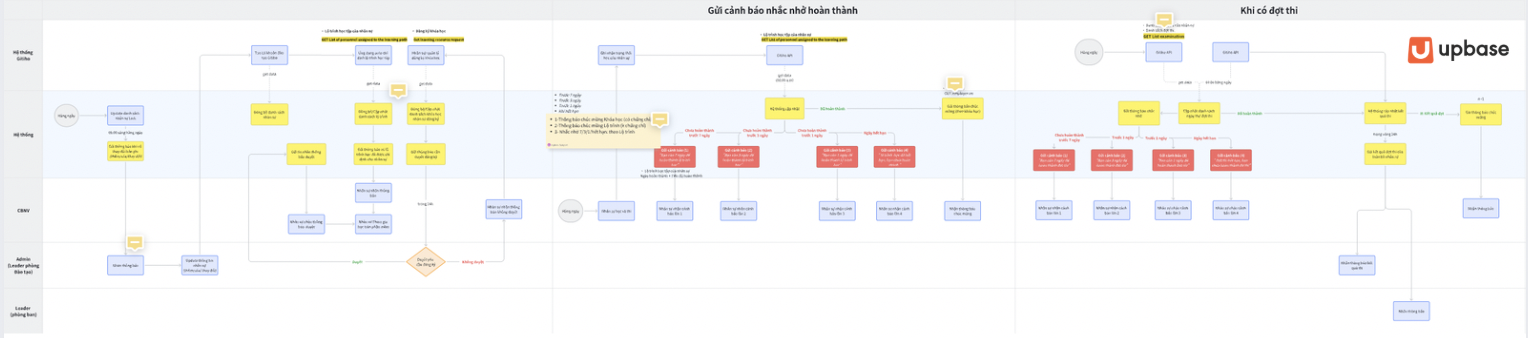
Đọc chi tiết case study tại: Case study: UpBase đồng hành chuyển đổi số Quản lý đào tạo cho chuỗi bán kính mắt Anna
3.5. Finance & accounting management
This is the central data hub that helps businesses control cash flow, inventory flow, and maintain financial transparency.
Payment management system (receivables & payables):
- Connect APIs with sales systems to manage invoices, invoice issuance requests, and requests for invoice adjustments or cancellations with explanation tracking.
- Standardize expense categories and approval workflows, including advances, payment requests, and reimbursement settlements.
- Integrate APIs to push payment requests and update payment statuses in real time.
- Automatically reconcile expenses against approved budget limits and alert businesses about overspending or process violations.
Payment reporting & cash flow management system:
- Manage cash and bank ledgers, cash flow statements, and periodic reconciliation of account balances.
- Manage recurring expenses such as store rental fees and fixed operational costs while automatically sending payment reminders based on contract timelines.
3.6. Strategic management & executive reporting (BOD)
This operational command center enables leadership teams to gain a comprehensive overview and make decisions based on data rather than intuition.
P&L reporting system:
- Automatically consolidate revenue, cost of goods sold, and operational expenses from all departments to generate detailed P&L reports by store, brand, sales channel, and product category.
- Compare actual performance against planned targets (Actual vs. Plan) to identify unusual fluctuations early.
Planning & approval management system:
- Allow the Board of Directors (BOD) to approve budgets, adjust spending limits, and authorize major business or marketing plans.
- Consolidate operational results from all departments, including HR, Marketing, Customer Service, and Procurement, into a single dashboard.
- Monitor cash flow health and inventory turnover ratios to optimize financial resources for future expansion plans.

4. Digital transformation for retail modules with no-code / low-code platforms
To digitize these operational modules, retail businesses have several options when choosing a technology platform. The most common approach is using specialized SaaS software for specific functions such as accounting or human resources. The biggest advantages of SaaS solutions are convenience, fast deployment, and relatively low initial costs. However, disconnected software systems are often difficult to integrate, forcing employees to manually input data multiple times while making it challenging for management to gain a comprehensive overview of the business. In addition, the limited customization capabilities of SaaS platforms often require businesses to adapt to predefined workflows instead of building processes that fit their unique operational needs.

On the other hand, comprehensive ERP systems can provide centralized data management and tightly structured operational processes. However, ERP implementation and maintenance costs are typically high, requiring long onboarding periods and offering limited flexibility. Whenever the market changes and businesses need to adjust even small operational workflows, modifying ERP systems often demands significant time and consulting expenses. This makes it difficult for retail businesses to adapt quickly to the fast-changing nature of the industry.
In this context, no-code and low-code solutions have emerged as a modern approach that combines the flexibility of customized software with the efficiency of modern technology. These platforms allow operational teams to design and adjust workflows themselves without requiring advanced programming knowledge. As a result, data across departments such as HR, Inventory, Accounting, and Sales can remain fully synchronized in real time.
Although no-code platforms require businesses to establish standardized SOPs and process-thinking from the beginning to avoid operational disorder, they offer high flexibility and allow systems to scale alongside the business without requiring a large IT team.
One of the most prominent platforms in this space is Lark Suite. Lark enables businesses to digitize approval workflows ranging from simple expense requests to complex multi-location inventory transfer processes within minutes. With Lark Base, businesses can build professional inventory management systems, supplier databases, and CRM platforms while also integrating APIs with existing POS or sales software.
By centralizing all operational activities into a single workspace on Lark, businesses can eliminate information silos and create a unified digital working environment where every decision is made based on real-time operational data.

5. Digital transformation roadmap for retail businesses with UpBase x Lark Suite
To implement digital transformation effectively, retail businesses need more than just technology tools, they require a comprehensive solution that combines the right platform with a practical implementation methodology. This is also the reason behind the partnership model between UpBase and Lark Suite, where UpBase operates as a Lark Platinum Partner to support businesses from system setup to real-world operational deployment.
The implementation roadmap is typically divided into clear phases, starting with operational standardization, followed by system digitization, performance measurement, and finally optimization and scaling. Each stage is tied to specific objectives, allowing businesses to transform step by step without becoming overwhelmed or deploying systems in a fragmented manner.
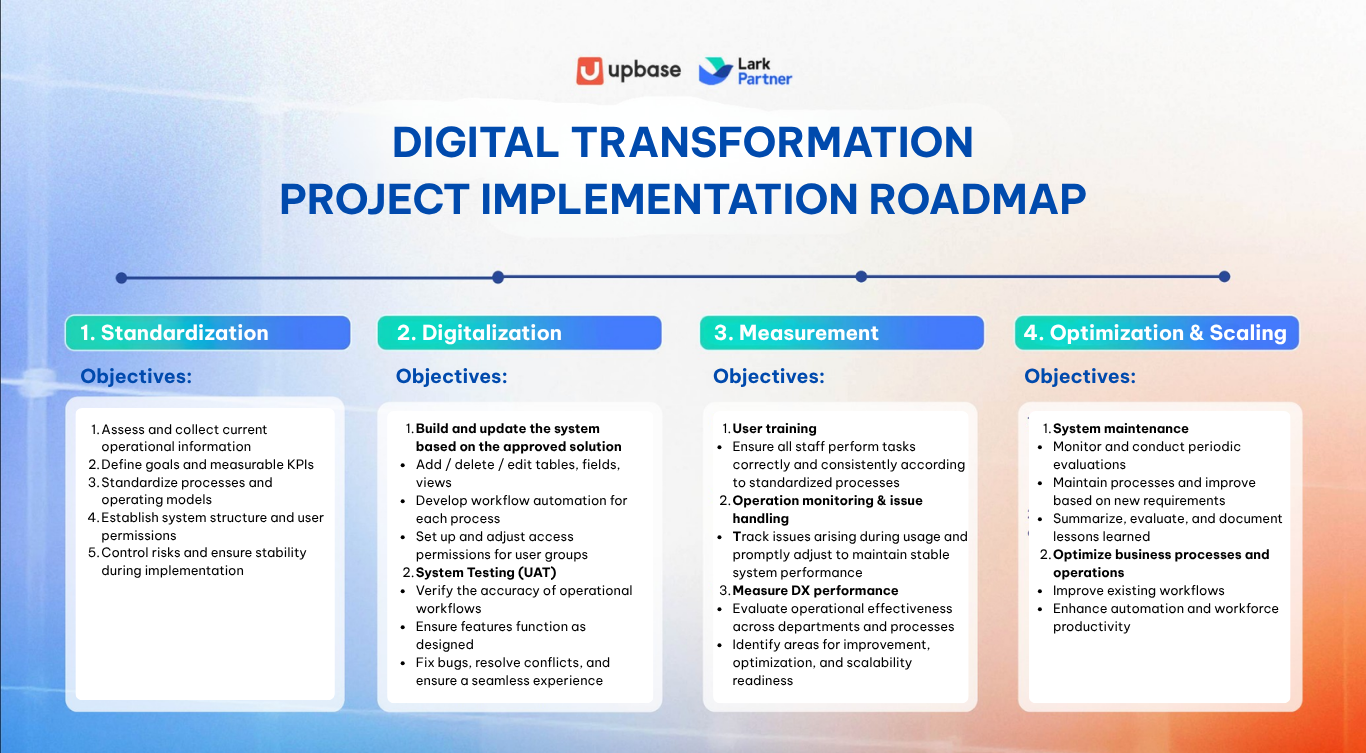
Instead of implementing disconnected tools separately, this approach helps retail businesses build a unified operational platform where data, processes, and people are tightly connected. As a result, businesses can establish a strong operational foundation for efficient long-term scaling. Contact UpBase to receive a customized digital transformation roadmap tailored specifically for your retail business.
.jpg)


.svg)

.svg)