Implementing Lark for Businesses Experience from UpBase – Lark Platinum Partner

In today’s business environment, where cross-functional collaboration and fast decision-making are increasingly critical, implementing a management platform like Lark Suite is no longer just about “installing a tool.” It represents a shift in management mindset and operational structure.
However, in reality, many businesses that have already adopted Lark are still not fully leveraging its value. Common issues include fragmented use of features, lack of standardized processes, and low user adoption across teams. This raises an important question: how can Lark be implemented not just to “function,” but to truly “drive effectiveness”?
From the perspective of a Lark Partner, one that has directly consulted and implemented solutions for companies across various sizes and industries. This article consolidates UpBase’s hands-on experience, highlights common pitfalls, and introduces a practical implementation framework to help businesses maximize the full potential of Lark Suite.
UpBase – Lark Platinum Partner in Vietnam

UpBase is proud to be a Platinum Partner of Lark in Vietnam, demonstrating our proven capability in delivering and consulting comprehensive digital transformation solutions for businesses. With hands-on experience across industries such as eCommerce and retail, we go beyond providing Lark Suite, we partner with businesses to optimize operations, enhance productivity, and build flexible digital ecosystems tailored to each business model. This milestone reinforces our position as a strategic partner, delivering practical value and driving sustainable growth for our clients.
What is Lark Suite?
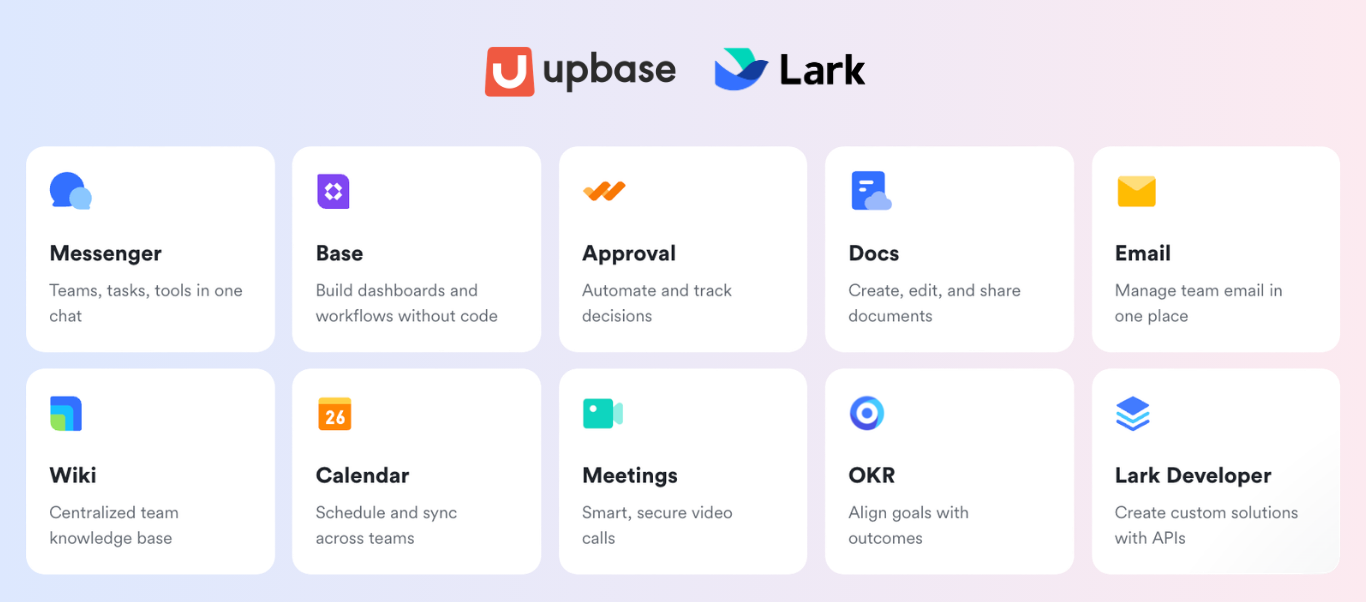
Lark Suite is an all-in-one enterprise collaboration and management platform developed by ByteDance. Instead of using multiple disconnected tools for chat, email, document management, or online meetings, Lark brings everything into a single unified ecosystem. From an operational perspective, Lark is not just a workplace tool, it functions as an operating system for businesses, where all internal activities are digitized and seamlessly connected:
- Internal communication: chat, video calls, online meetings
- Document management: real-time shared docs, sheets, and wiki
- Scheduling & task management: calendar, tasks, reminders
- Workflows & approvals: workflow automation, approval processes
- Internal database: Base (no-code database), dashboards
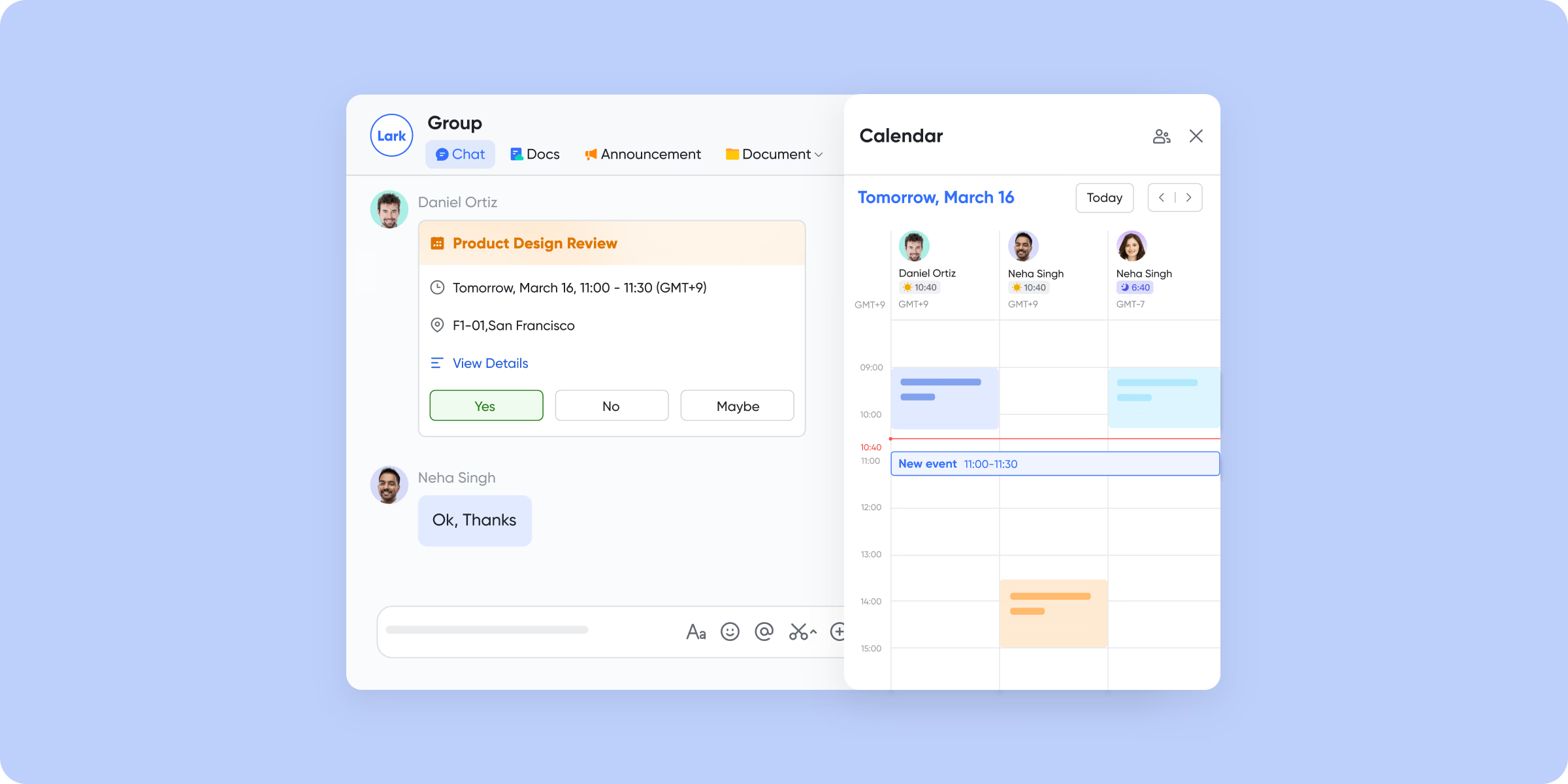
One of Lark Suite’s core philosophies is chat-centric, meaning conversations are at the center of all work activities. Unlike traditional tools where communication and execution are separated, Lark allows users to create tasks directly within chats, attach documents (Docs) or databases (Base), assign owners, set deadlines, and even process approvals/workflows without leaving the conversation.
In reality, many businesses face a common issue: information lives in chat, while actions happen on different platforms. This leads to context loss due to constant switching between tools, lack of transparency when task origins are unclear, and difficulty in tracking progress because discussions and execution are disconnected. With its chat-centric model, Lark effectively solves this by tightly integrating communication with execution, turning each conversation into a “mini workspace” and ensuring that the entire history of discussions and actions is maintained within a single unified thread.
Comparison with other platforms: Slack primarily focuses on messaging and requires additional integrations like Google Drive or Microsoft Office for full functionality. Microsoft 365 or Google Workspace offer comprehensive office and meeting tools, but they are often separated into different products (e.g., Teams, Office apps, etc.). In contrast, Lark consolidates everything into a single interface. As a result, Lark is often seen as a more streamlined solution for businesses looking to simplify their IT infrastructure instead of using Slack + Google + Zoom + Asana, companies can rely on one unified platform with lower management overhead.
Benefits of Using Lark - All-in-One Platform
The shift toward an all-in-one platform like Lark Suite brings significant strategic advantages for businesses:
- No-code/Low-code: One of the standout advantages of low-code/no-code platforms is the ability to build and customize internal applications with little to no coding. With tools such as Base, Workflow Automation, and Approval, businesses can quickly create forms, approval processes, management dashboards, or internal systems (CRM, HRM, project tracking, etc.) using simple drag-and-drop operations. This addresses a major pain point of traditional SaaS solutions: limited customization to fit specific business needs. Instead of forcing processes to fit the tool, businesses can build systems around their actual workflows. Additionally, compared to developing custom systems or implementing complex ERP solutions, Lark’s no-code/low-code capabilities significantly reduce upfront investment, implementation time, and maintenance costs.
- Increased productivity and collaboration: When all tools (chat, meetings, documents, calendars, project management, etc.) are unified in one platform, users only need to learn and log into a single system. This eliminates the fatigue of constantly switching between applications, while notifications are seamlessly delivered via chat across all devices. Teams can communicate in real time, share files, assign tasks, and approve work within the same workflow, improving processing speed and transparency. Built-in features like notifications and automated reminders also help ensure projects stay on track without additional management effort.
- Reduced Total Cost of Ownership (TCO) and management costs: A unified platform minimizes licensing and support costs compared to using multiple vendors. Businesses only need to manage one provider and one infrastructure system (servers, storage, security, data management) instead of several separate services. For example, Lark Suite offers a free plan for small businesses and a per-user pricing model (around $6/user/month), which is typically more cost-effective than enterprise setups like Microsoft Teams + Office or Slack + Google Workspace. By consolidating into a single solution, IT teams can optimize operations, reduce system conflicts, and improve cost control.
- Security and compliance: Using a single platform simplifies information security management. Lark Suite complies with international security standards (ISO/IEC 27001, SOC 2 Type II, GDPR, etc.) and provides centralized administration tools, including login control, data encryption, and granular access permissions. This is more efficient than managing and updating security policies across multiple disconnected platforms. While businesses still need to establish clear internal policies (e.g., enforcing 2FA, managing endpoint devices), a unified platform helps concentrate security efforts in one place.
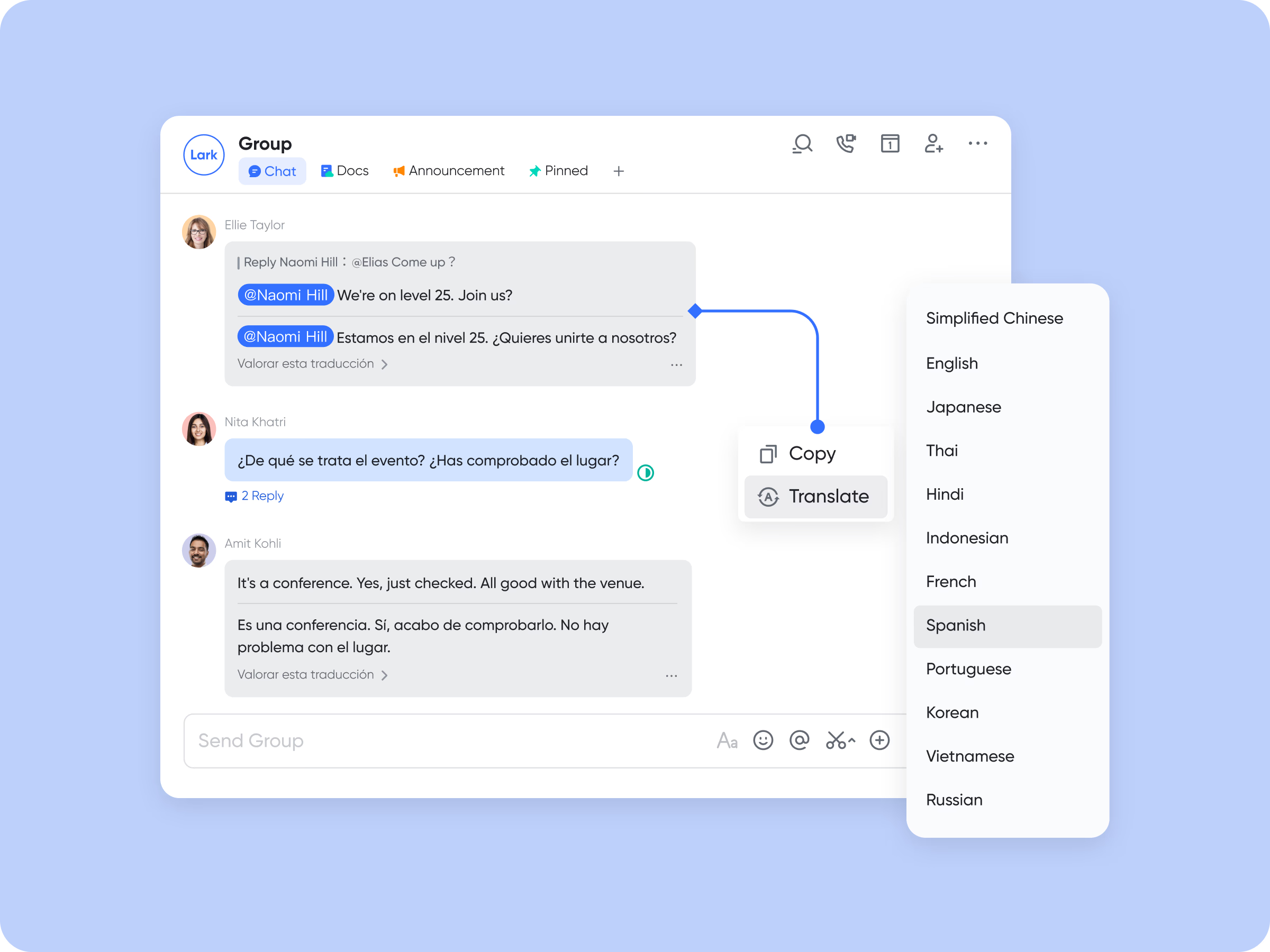
- Remote and hybrid work enablement: As remote and hybrid work become increasingly common, a unified platform is key to maintaining seamless collaboration. Lark offers built-in video meetings (Lark Meeting) and cross-platform chat (web, desktop, mobile), ensuring connectivity anytime, anywhere. All documents and conversations are cloud-synced, allowing remote employees to stay continuously updated. Notably, the built-in auto-translation feature enables smooth communication for global teams. As a result, geographical distance becomes less of a barrier: data and communication channels are centralized within Lark, enabling faster decision-making and execution regardless of where employees are located.

Common Mistakes When Implementing Lark
Experience from multiple Lark implementation projects (as well as other collaboration platforms) shows that businesses often encounter the following common mistakes:
- Unclear implementation goals: Many projects rush into deploying new tools without defining clear objectives (often stating vague goals like “improve productivity” or “modernize technology”). As a result, projects easily lose direction, and teams continue working based on intuition. UpBase recommends applying the SMART framework - for example: “reduce online meeting time by 20% by transitioning to Lark Calendar + Meeting within 3 months.” If goals are not measurable, it becomes difficult to evaluate progress or maintain momentum.
- Poor communication and change management: Implementing a new platform requires continuous communication. A common mistake is failing to clearly communicate benefits and rollout plans to the team. This leads to confusion, improper usage, or even resistance to change. Lark provides built-in tools such as chat and announcement channels to organize kick-off meetings, share step-by-step guidance, and collect feedback. Leveraging Lark Messenger for task-based discussions and updates helps keep everyone aligned. Without proper communication, employees often revert to old tools like Zalo or email, abandoning the new system.
- Lack of progress tracking: Without measurement or progress tracking, projects are prone to delays. Traditional spreadsheets quickly become outdated without proper reporting tools. Businesses should utilize tools like Timeline, status updates via Lark Base, or task management systems (e.g., Kanban boards) to closely monitor progress. For instance, Lark offers OKR management templates with Gantt charts for visualizing project timelines. Skipping this step means organizations cannot identify inefficiencies or make timely adjustments.
- Insufficient training and change management: Another mistake is assuming employees will “figure out” how to use Lark or relying on a single introductory training session. In reality, each department has different needs (marketing, sales, technical teams, etc.). Without role-based training (e.g., documentation teams, project managers, customer support), users tend to treat Lark as just another chat app, underutilizing features like Lark Docs or Base. A structured training roadmap from basic to advanced, along with function-specific documentation and regular knowledge-sharing sessions is essential.
- Fragmented and inconsistent implementation: A common issue is allowing departments to independently build their own Lark Base apps or chat channels without standardization. For example, some businesses create separate order management tables for sales and warehouse teams without integration, leading to fragmented data and inconsistencies. Instead, companies should standardize processes (e.g., syncing sales orders from Lark Base to accounting systems) to ensure a single source of truth and better control.
- Underutilizing automation capabilities: Lark Base and Workflow Automation are powerful features but are often overlooked. Many businesses continue to rely on manual Excel/Google Sheets processes even after adopting Lark. For instance, before using Lark Base, 7-Eleven Philippines relied on spreadsheets for store quality checks, lacking real-time data and automated reporting. By standardizing processes within Lark Base, they enabled real-time updates to dashboards, reduced data entry errors, and shortened reporting time. Businesses should treat Lark Base as an internal ERP/CRM tool: building forms and automated reports instead of relying on manual workflows.
- Weak governance and security practices: Implementing multiple features without clear governance can lead to confusion and misuse. For example, inconsistent naming of chat channels or storage folders can quickly make the system cluttered. Additionally, without proper security configurations (SSO, 2FA, data policies), sensitive information may be exposed through chats or shared files. To avoid this, businesses should establish clear governance policies, encourage SSO adoption (to sync authentication with internal systems), and regularly audit users and permissions via Lark’s admin center.
- Lack of performance tracking (KPIs): Without evaluating outcomes after implementation, businesses struggle to measure value. For example, if metrics such as Lark usage rates (active users, number of meetings, response time) are not tracked, teams cannot determine whether goals are achieved. It is essential to define KPIs such as usage frequency (DAU/MAU for Lark Messenger, Docs, Base), task completion rates (tracked via Lark Base), and user satisfaction after each implementation phase.
Lark Suite Implementation Process for Businesses
When implementing Lark Suite, businesses should not treat it as simply installing a new tool, but rather as a transformation in how operations, collaboration, and work management are conducted across the organization. Below is a suggested implementation process to help businesses structure the necessary steps. Depending on company size, readiness, and operational specifics, these phases can be flexibly adjusted to better fit real-world conditions.
- Define & plan: The project team, including executive sponsors, a project manager (PM), IT team, and implementation partner, works together to define objectives, scope, and KPIs. Roles are then clearly assigned: team lead (managing timelines), technical specialists (system configuration), and change management experts (training planning).
Deliverables: implementation roadmap, RACI matrix, internal communication plan, etc. - Technical setup: The IT team installs and configures Lark according to the company’s structure, including internal domain setup, SSO/Active Directory integration for user synchronization, initial chat channels/topics setup, Lark Drive deployment, and security configuration (access control, two-factor authentication). At the same time, Lark is integrated with existing systems if needed (e.g., Google Workspace, Microsoft 365, CRM, ERP) via Lark APIs or middleware.
Deliverables: a fully configured Lark system, SSO login testing, and a data migration plan (if applicable). - Process design & migration: The implementation partner and IT team design workflow templates in Lark Base aligned with internal processes (e.g., content calendars, project management, approval workflows). Many companies leverage Lark Base templates (such as OKR Gantt templates for task allocation and visual progress tracking). If data migration is required (emails, files), the team executes the transition - for example, importing documents from Google Drive to Lark Drive or transferring contacts and parts of calendars. All changes are tested with a pilot group to ensure stability before full rollout.
- Training & change management: Conduct detailed training sessions tailored to user roles (via workshops, documentation, and e-learning). Leadership plays a critical role by leading adoption: directors and managers actively use Lark for meetings, document sharing, and feedback to set an example. This is supported by internal communication campaigns (tutorial videos, infographics, support chat groups) to address user questions.
Deliverables: training materials, demo videos, company-specific FAQs. During this phase, a pilot group uses Lark to test and provide feedback, helping refine the solution before organization-wide deployment. - Launch & monitoring: Roll out (Go-Live) across the entire organization. The implementation partner provides hands-on support during the initial phase, while the IT team monitors system performance. After launch, the project team continuously tracks KPIs (e.g., daily active users on Lark, number of meetings, documents edited, post-training satisfaction levels, etc.).
Throughout this process, change management is a critical success factor. Businesses must maintain strong internal communication, actively listen to feedback, and remain flexible in making adjustments. Lark Suite supports this through chat channels and feedback forms. Finally, establishing internal “champions” within each department helps drive adoption, share knowledge, and ensure long-term, effective use of the platform.
Best Practices for Effective Lark Implementation from a Lark Platinum Partner
Drawing from multiple successful projects by UpBase, here are key best practices and tools to ensure an effective Lark implementation:
- Build a digital culture step by step: Instead of forcing adoption, guide users gradually. Start with everyday activities (online meetings, team chat), then expand to document management and automated workflows. Celebrate small wins (e.g., reduced meeting time, less paperwork) to build trust and momentum.
- Leverage ready-made Lark Base templates: The system offers a wide range of built-in templates (such as OKR & Gantt planning, campaign planning, Kanban task boards, etc.). Utilizing these templates helps accelerate process setup.
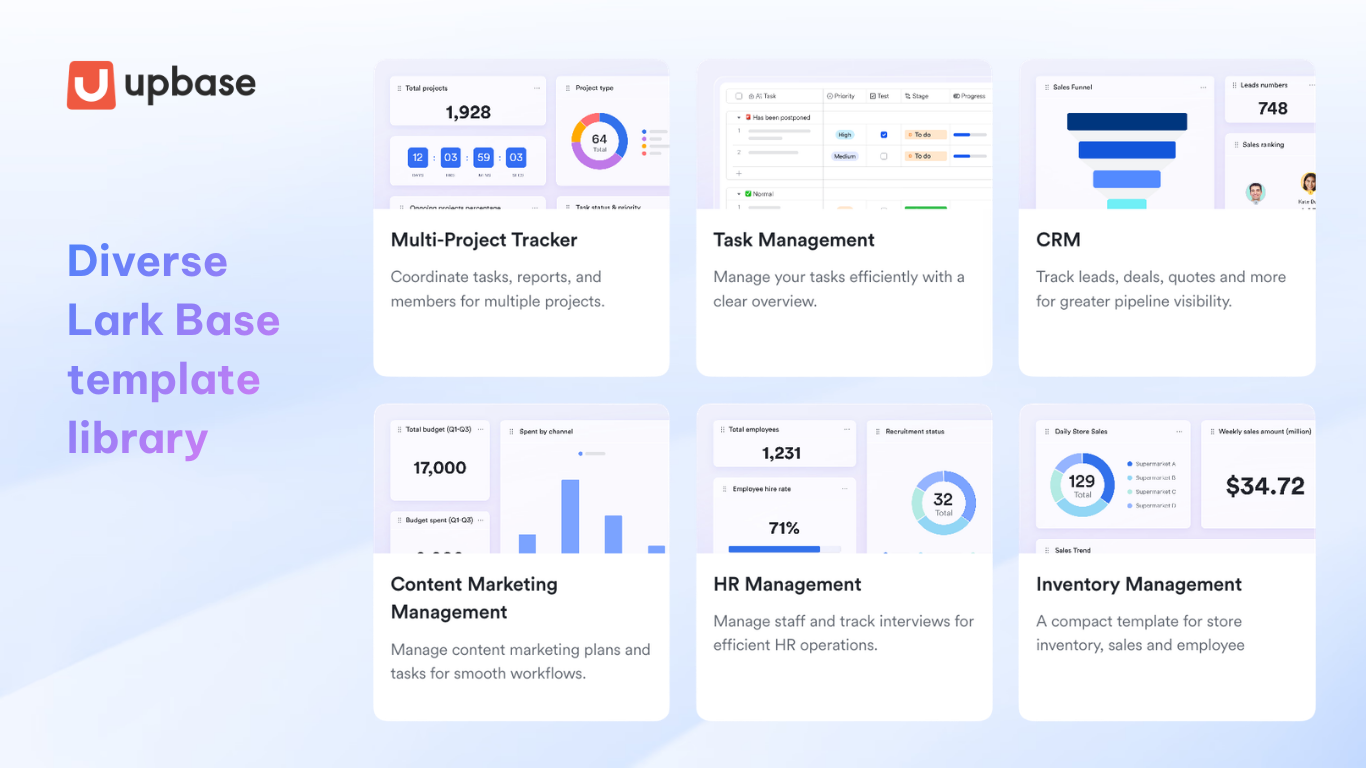
- Measure and evaluate clearly: Define KPIs from the beginning, such as user activity rates, number of shared documents, average task completion time on Lark Base, and employee satisfaction. Use Lark’s built-in reporting (upcoming) or custom dashboards in Lark Base for continuous tracking.
- Drive user adoption strategically: Motivate users through internal initiatives such as competitions between departments, awarding “badges” to active users, or integrating Lark Base with internal reward/benefit systems. At the same time, regularly update users on new features through short training sessions. This ensures Lark becomes part of daily workflows rather than being overlooked.
- Customize and personalize the experience: Depending on company culture, Lark allows customization of domain, logo, and interface colors. For example, companies can display their branding on Lark’s interface or build internal chatbots for cultural announcements. This increases familiarity and makes the system feel truly “owned” by the organization.
- Establish strong governance and security policies: Enable advanced security features (multi-factor authentication, confidential file restrictions, external sharing controls). At the same time, standardize naming conventions for channels/projects and manage access permissions to keep the system organized. Some large organizations even conduct periodic audits of Lark Drive data to clean up unused files and optimize storage.
- Provide continuous training and 24/7 support: Be ready to support users through FAQs, chatbots, or internal help desks. While Lark Suite offers enterprise support, during the implementation phase, companies should have at least 1–2 internally trained experts to handle common issues promptly.
Applying these practices ensures that Lark Suite is not just implemented, but truly utilized effectively, making workflows more structured, digitized, and flexible, ultimately improving productivity and reducing operational costs.
When Should Businesses Work with a Lark Partner?
Not every business has the internal expertise to independently implement an operational platform like Lark, especially small and medium-sized companies or organizations with limited IT experience. In such cases, partnering with a Lark Partner becomes the optimal choice to minimize risks and save internal resources. Implementation partners (Lark Partners) not only provide technical services but also deliver end-to-end value, from consulting on process design tailored to the business, standardizing system configuration, integrating with existing platforms, to data migration, user training, and post-implementation support.
In particular, working with Lark Platinum Partners ensures the highest level of implementation capability, along with strict SLA commitments, including fast response times, direct involvement from senior experts, and the ability to handle complex requirements within short timelines. As a result, the system is not only deployed quickly but also operates smoothly from the early stages.
In summary, working with a Lark Partner provides four core benefits:
- Faster implementation: With hands-on experience and standardized processes, Lark Partners significantly shorten deployment timelines, minimize setup errors, and bring systems into operation faster than expected.
- Right structure from the start: Businesses receive guidance in designing systems aligned with their operating models, ensuring well-structured data, access control, and workflows from the beginning, avoiding complex rework later.
- Maximized feature utilization: Beyond implementation, Lark Partners help businesses fully leverage the platform’s capabilities, from task management and automation to integrations, optimizing overall operational efficiency.
- Long-term support: Businesses have a dedicated team to provide ongoing support, resolve issues, update systems, and continuously recommend improvements, ensuring Lark evolves alongside the organization.
In addition, businesses can benefit from cost advantages (discounts) offered by partners, as Lark Partners often provide more competitive pricing compared to direct subscriptions especially for large-scale or long-term projects. Companies also gain access to continuously updated best practices and real-world implementation experience across industries, helping them avoid common pitfalls and quickly adopt effective models.
Given these benefits, choosing the right Lark Partner from the outset plays a crucial role in ensuring successful implementation and long-term operational optimization. Businesses can refer to the official list of Lark partners by region here: APAC partner directory.
Lark Implementation Process at UpBase – Lark Platinum Partner
UpBase is proud to be a Platinum Partner of Lark (the highest partner tier) demonstrating advanced capabilities in implementation, consulting, and end-to-end support for businesses. With hands-on experience across diverse industries, UpBase does not simply deploy Lark as a tool, but builds an optimized operating system tailored to each organization’s unique needs. Therefore, UpBase’s implementation process is structured into four key phases: standardization – digitization – measurement – optimization & scaling, enabling businesses to systematically build a robust operating model, ensure correct implementation from the start, achieve operational efficiency, and remain scalable for long-term growth.
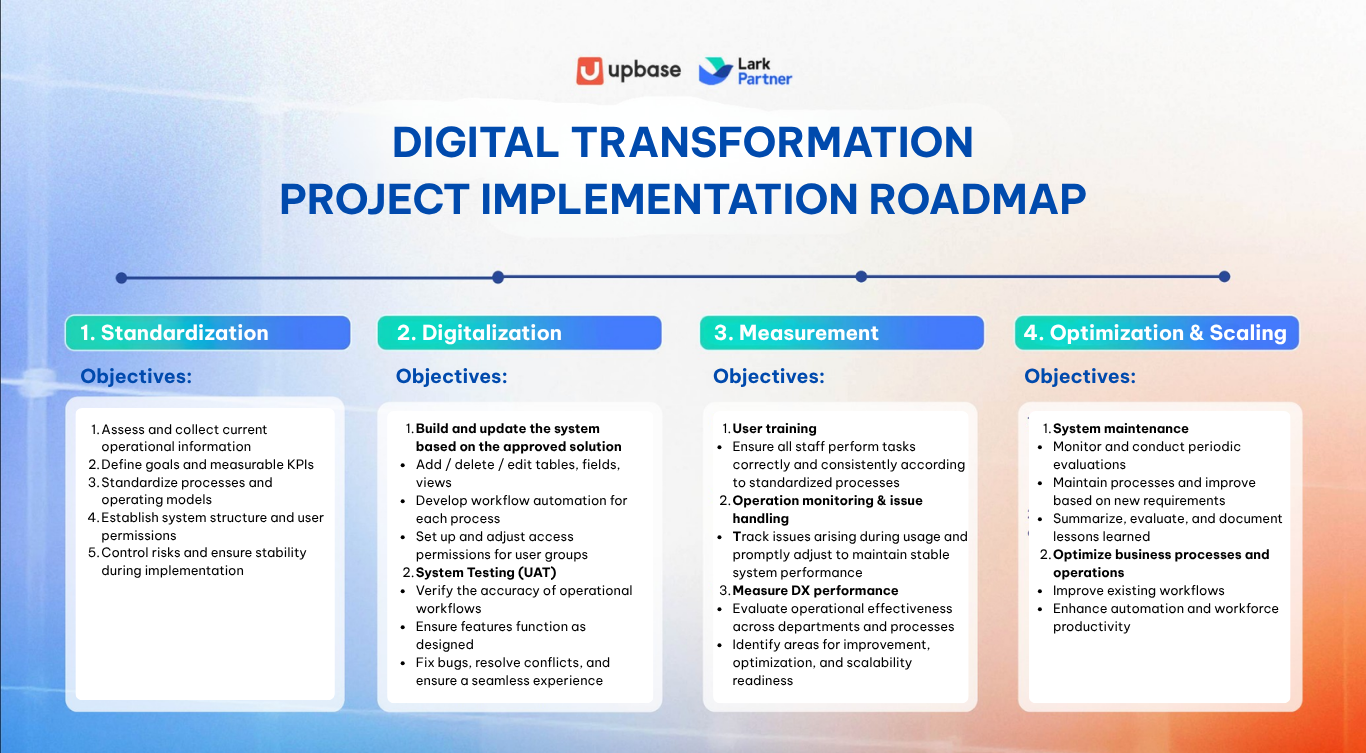
As a Lark Platinum Partner, UpBase goes beyond basic tool setup and works closely with businesses to redesign processes aligned with organizational needs, helping optimize costs, improve productivity, and unlock innovation potential. Additional value-added services include custom development (Lark-based apps), deep integration with internal systems, 24/7 SLA support, and enhanced service commitments. In many cases, businesses are also advised on process improvements before transitioning to Lark, ensuring maximum value from the platform.
Results from UpBase’s internal implementation highlight the impact: feedback time was reduced by 55% through centralized communication and automated notifications on Lark; on-time task completion rates increased from 65% to 92%; and approval processes via Lark Approval became 80% faster compared to traditional email workflows. Moreover, 87% of UpBase employees reported reduced stress levels due to less “deadline firefighting.” These figures demonstrate that Lark not only solves immediate operational challenges but also creates long-term competitive advantages in speed and transparency.
.jpg)



.svg)

.svg)