Social Commerce vs eCommerce: How do these two models differ?

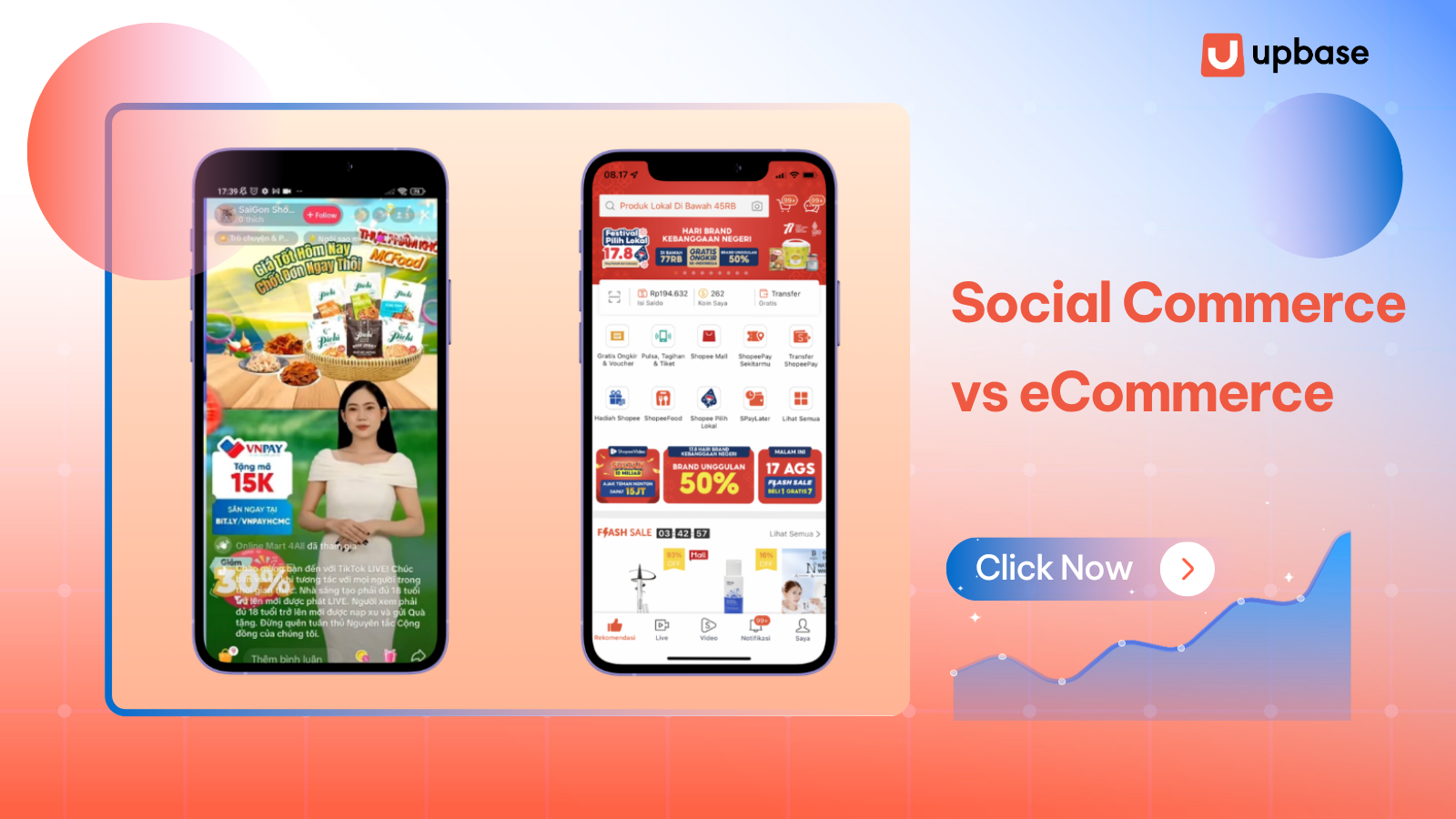
Since the 2018–2019 period, when the eCommerce market in Southeast Asia and Vietnam entered a phase of rapid growth, the concept of “eCommerce” has become familiar to most businesses. However, after this boom, consumer behavior, especially among Gen Z, is changing rapidly, causing traditional eCommerce models to gradually plateau and give way to the rise of Social Commerce. So, is Social Commerce replacing eCommerce? How do these two models differ, and which channel should businesses choose to scale?
Definition of Social Commerce and eCommerce
eCommerce, in simple terms, refers to the buying and selling of goods or services via the Internet and other electronic means. The WTO provides a broader definition: “the production, distribution, marketing, sale, or delivery of goods and services by electronic means.” In general, eCommerce business models operate in three main ways:
- Businesses own their own eCommerce websites that sell only their branded products
- Businesses operate storefronts and sell on third-party eCommerce platforms such as Shopee or Lazada, or use integrated eCommerce platforms like Shopify, WooCommerce, or Magento alongside their existing websites
- A hybrid model combining both owned eCommerce websites and third-party platforms
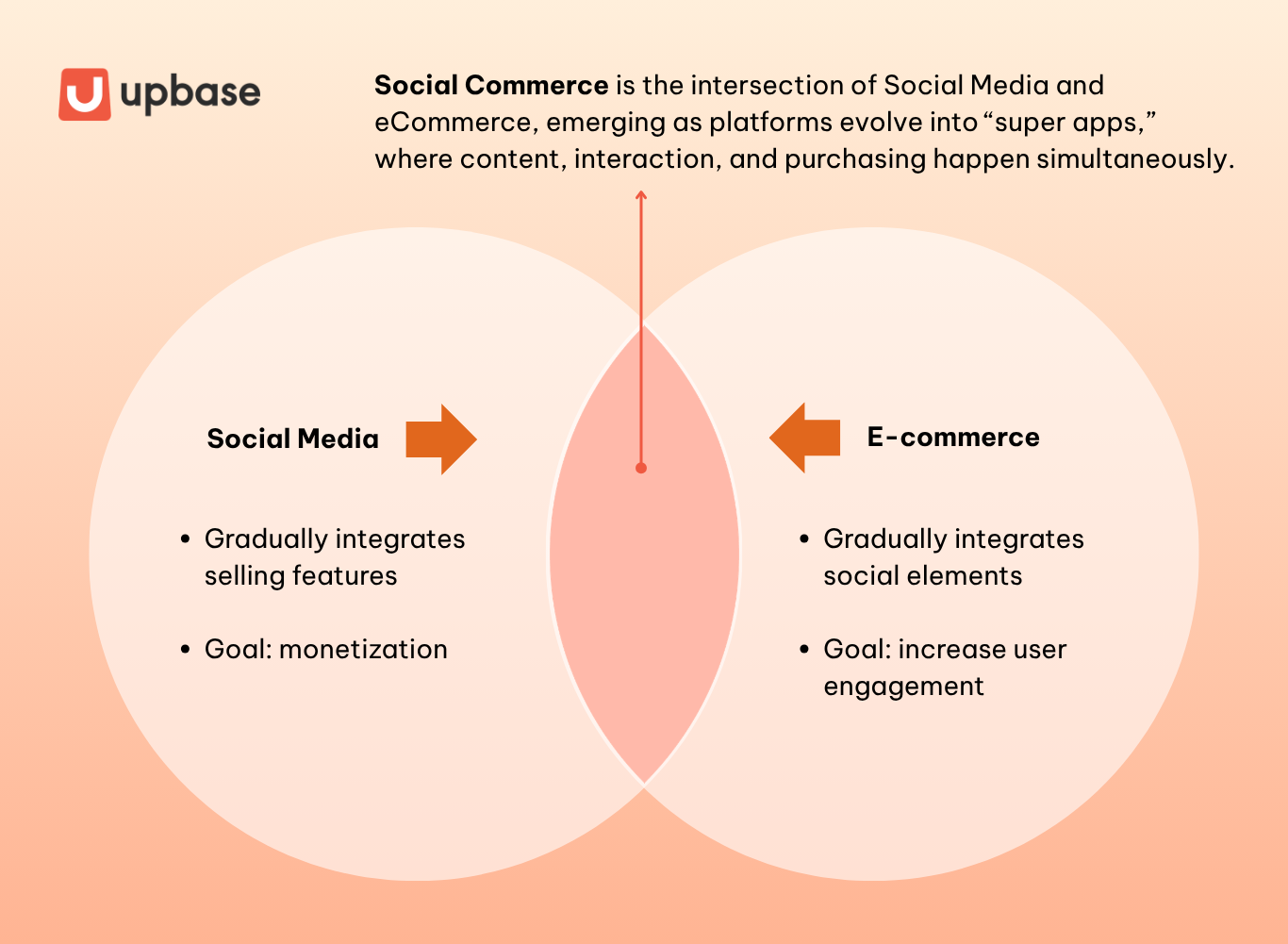
Social Commerce is a form of eCommerce that closely integrates social media with shopping activities. In other words, it leverages community-driven content, livestreaming, and influencers on platforms such as Facebook, Instagram, TikTok, and Zalo to stimulate demand and enable transactions directly within social environments. Social Commerce can involve in-app checkout or redirect traffic to dedicated shopping pages, but it always revolves around social interaction and engaging content.
Read more about Social Commerce: Social Commerce from A–Z: A New Growth Trend from Social Media
How is Social Commerce different from eCommerce?
Social Commerce is a subset of eCommerce, it does not completely replace it. While eCommerce is more transaction-driven (customers actively search for products), Social Commerce emphasizes spontaneous, entertaining, and socially driven experiences throughout the buying journey.
The core difference between Social Commerce and eCommerce lies in demand creation vs. demand capture:
- Demand Creation: The goal is to make consumers aware of and interested in new brands or products. Common tools include engaging content, viral advertising, influencer marketing, educational livestreams, and short-form videos. Social Commerce operates mainly in this direction, it leverages social media and interactive content to capture the attention of users who may not yet have purchase intent (e.g., entertaining videos or product launch livestreams). As a result, Social Commerce can rapidly expand the pool of potential customers, generate new demand, and stimulate purchase desire.
- Demand Capture: This focuses on converting existing purchase intent. Customers who are already in the consideration or decision stage are “captured” through channels such as search, remarketing, display ads, email, or major eCommerce marketplaces, where they actively look for products or services. Traditional eCommerce excels here: when customers know exactly what they want (e.g., searching for “buy XYZ phone”), eCommerce platforms step in to convert that demand into transactions through features like product listings, carts, and checkout.
In summary, Social Commerce focuses on building awareness and stimulating new demand, while eCommerce focuses on converting existing demand into actual transactions. Social Commerce systems often create a more “closed-loop” journey, from discovery to purchase directly within social platforms, with a fast and seamless process, sometimes enabling purchases in just one tap. In contrast, eCommerce provides a more structured and detailed buying journey (search, compare, add to cart, checkout) and performs best when customers already know what they need.
Therefore, an effective marketing strategy should combine both: create demand through Social Commerce, then capture and convert it through eCommerce.
Detailed Comparison: Social Commerce vs. eCommerce
Social Commerce and eCommerce: Integrating to Maximize Touchpoints
In practice, high-performing businesses do not treat Social Commerce and eCommerce as separate or competing channels. Instead, they operate them as interconnected touchpoints within a unified customer journey. As user behavior becomes increasingly fragmented across multiple platforms, maintaining consistency, from content and messaging to product information, has become more critical than ever to ensure a seamless experience.
Specifically, Social Commerce often serves as the entry point, where customers first encounter products through content, KOLs, or communities, thereby building awareness and generating demand. Meanwhile, eCommerce functions as the conversion hub, where customers explore further, compare options, and make purchase decisions with sufficient information and trust.
If businesses focus solely on eCommerce, they risk missing a large segment of customers who have not yet formed clear purchase intent. On the other hand, relying only on Social Commerce may generate demand but fail to convert it effectively into revenue due to the lack of supporting systems. Therefore, instead of asking “which channel to choose,” businesses should focus on integrating platforms in a synchronized manner to maximize touchpoints and optimize the entire customer conversion journey.
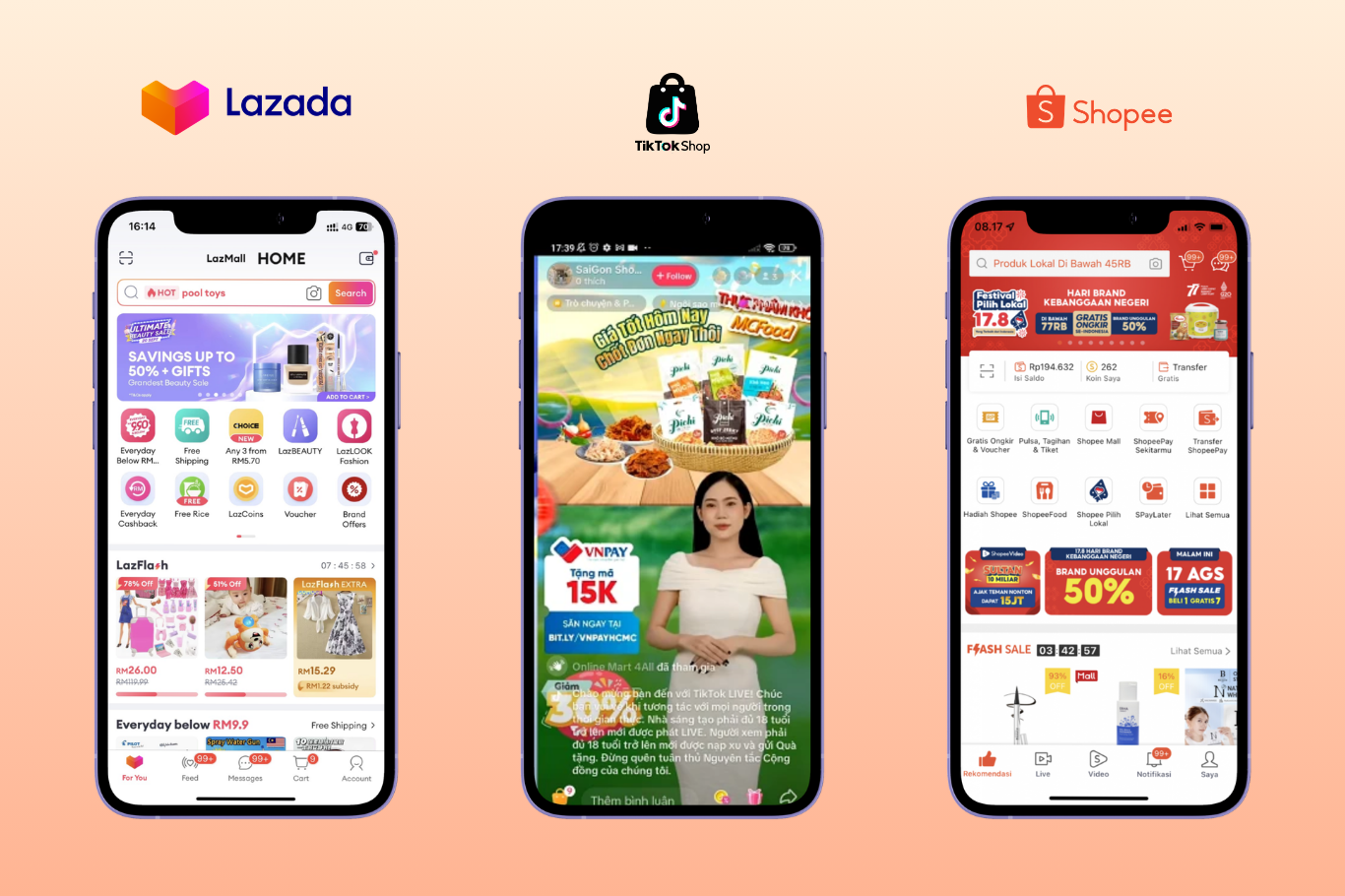
To ensure that Social Commerce and eCommerce truly complement each other, rather than operating in silos, businesses need to design a seamless journey where customers are naturally guided from discovery to purchase. Below are key principles to help maximize conversion in this model:
(1) Align information between Social and marketplaces
One of the most common “breakpoints” in the customer journey is inconsistency between social content and marketplace information.
After watching a video on TikTok or Facebook, users often search for the product on platforms like Shopee or Lazada to verify it. If the visuals, messaging, or pricing do not match, trust is quickly lost and users drop off.
Therefore, businesses must ensure that every touchpoint communicates the same story and value proposition. Social content and marketplace product listings should be consistent in visuals, messaging, and positioning. Pricing, promotions, and offers should be aligned, or intentionally differentiated with clear strategy.
(2) Design clear handoff points
Customer interest does not automatically translate into purchase. In reality, without guidance, most users will drop off between steps.
Businesses should proactively design clear handoff points: embed product links in bios, videos, or livestreams, and use direct calls-to-action such as “View product on Shopee.”
The fewer steps involved, the higher the conversion rate. Conversely, every unnecessary step significantly reduces the likelihood of purchase.
(3) Optimize marketplace experience as a landing page
When customers move to an eCommerce platform, they are no longer in the “discovery” stage but in the “consideration” stage. At this point, everything is compared side by side.
Product pages should therefore be optimized like full landing pages: visuals and content must align closely with what customers saw on social; reviews and ratings should be strong enough to build trust; and promotions must be clear to drive decision-making.
In other words, the marketplace is not just a sales channel, it is the final conversion point of the entire journey.
(4) Leverage the Social–eCommerce loop
The customer journey does not end after a purchase is completed. In fact, this is when businesses can activate a new growth loop.
After purchase, customers can be remarketed via platforms like Facebook or TikTok, encouraged to share experiences, or create review content. This user-generated content then becomes a new trigger for future customers.
When executed effectively, Social Commerce and eCommerce are no longer separate channels, but a continuous loop, where demand is created, converted, and regenerated.
How to Effectively Integrate Social Commerce and eCommerce
To truly unlock the potential of Social Commerce and eCommerce, businesses need more than just a presence across multiple channels. What matters is adopting an Omnichannel mindset, where all touchpoints are seamlessly connected into a unified and consistent experience. Whether customers start their journey on social media, a website, or an eCommerce marketplace, they should receive the same messaging, information, and smooth experience throughout.
An effective framework, therefore, is not about separating channels but about integrating and synchronizing operational layers. Specifically, businesses should focus on four core elements: Content – Touchpoints – Data – Operations.
1. Content Alignment
Content is the starting point of the entire system, especially on platforms like TikTok and Facebook. However, it’s not just about “creating content,” but ensuring full consistency between social content and marketplace product information. Businesses should:
- Develop a unified core message for each product
- Ensure visuals, USPs, and messaging on social match product pages on Shopee or Lazada
- Avoid inconsistencies where “content says one thing, the product page says another”
Goal: When customers move from social to marketplace, the experience feels seamless and expectations remain aligned. Customers don’t restart their journey, they simply continue it.
2. Touchpoint Synchronization
In reality, very few customers purchase immediately after seeing content. Most will return later to search, compare, and validate before deciding. Without clearly designed transitions, this journey becomes fragmented.
Businesses must shift from “being present on multiple channels” to actively guiding customers across channels. This includes:
- Standardizing product links (bio, videos, livestreams, landing pages)
- Aligning product names and SKUs across platforms
- Clearly designing handoff points: social → marketplace → chat → CRM
Goal: Reduce friction across the entire journey and prevent customers from “finding their own way.” In a well-designed system, customers don’t need to think about the next step, they simply follow the flow.
3. Data Integration & Measurement
Most businesses measure performance by channel: social tracks views and engagement, while eCommerce tracks revenue and conversions. However, this approach overlooks a critical question: how the customer journey actually unfolds.
In an Omnichannel model, the goal is not just to know how much you sell, but where customers come from and why they convert. This requires connecting data across content, traffic, and revenue. Businesses should:
- Track cross-channel customer journeys (social → marketplace → purchase)
- Connect data between ads, content, and revenue
- Identify which content creates demand and which products drive conversion
Goal: Move beyond “how much was sold” to understand “where it came from and why.” This enables businesses to distinguish between content that drives real demand versus content that only generates views, forming the foundation for systematic optimization.
4. Operational Alignment & Optimization
Finally, a system is only effective if it can continuously optimize and scale over time. This requires Social Commerce and eCommerce to operate not as separate departments, but as tightly connected systems sharing goals and data.
In practice, strong content is not just about generating views, it must be validated by its ability to drive revenue. High-performing content should be fed back into product pages, ad strategies, and the overall sales system. Conversely, marketplace data (reviews, purchase behavior, best-selling products) should inform future content strategies. Businesses should:
- Continuously test content on social → drive traffic → measure conversion on marketplaces
- Optimize products based on feedback (reviews, comments, chats)
- Reuse high-performing content (UGC, best-performing videos)
Goal: Turn the system into a continuous loop: Test → Scale → Optimize → Repeat. Once this loop is established, businesses shift from running isolated campaigns to operating a sustainable growth engine, where each iteration improves upon the last.

End-to-End Social Commerce Solutions by UpBase
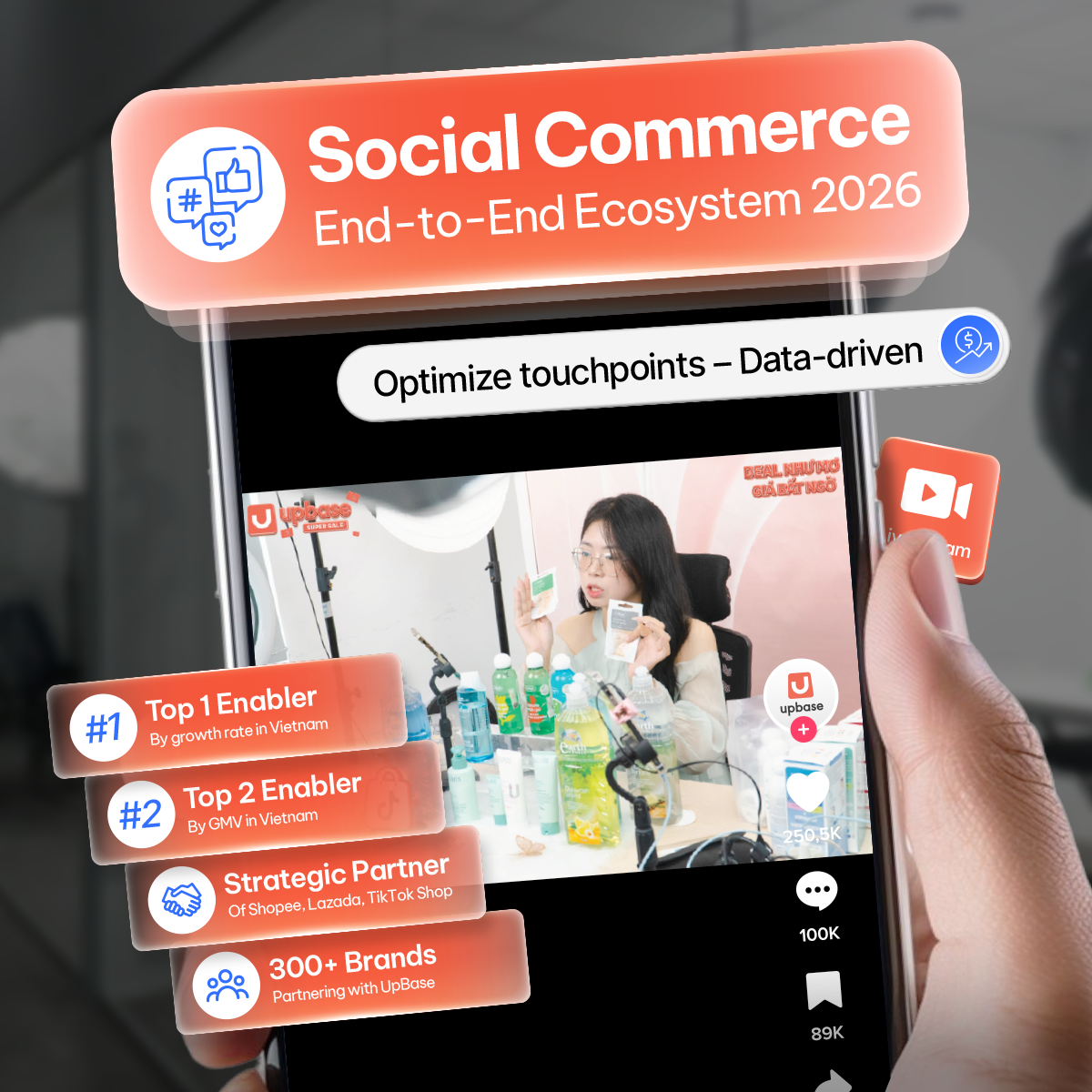
To execute Social Commerce effectively, businesses need more than just strategy, they require a deeply integrated and well-synchronized operational system. This is how UpBase builds a 360° Social Commerce ecosystem, connecting the entire journey from traffic → conversion → sustainable growth:
- Large-scale livestream operations: Standardized live studio systems, optimized scripting, and real-time traffic orchestration to control performance and ROI for each session
- Booking & Affiliate (KOL/KOC): A cross-industry creator network evaluated based on actual performance, helping brands select the right partners and maximize conversions
- Short Video & AI Creative: Fast, flexible content production enabling brands to scale across multiple platforms with optimized costs
- Media & Ads Performance: Continuous budget management and optimization based on real-time data, rather than post-campaign evaluation
What sets UpBase apart is not individual services, but how everything is integrated into a seamless operating system, where Social Commerce becomes a true growth engine, rather than just an additional sales channel. With this approach, Social Commerce goes beyond simply “selling on social media” and evolves into a scalable, data-driven system for sustainable growth. Contact UpBase today for consultation!
.jpg)



.svg)

.svg)